
Imagine contributing to a savings account where your money grows freely without being taxed, year after year. For Canadian investors, understanding how TFSA growth works is essential for maximizing wealth over time. Unlike traditional taxable accounts, a Tax Free Savings Account (TFSA) allows interest,
dividends, and capital gains to accumulate entirely tax-free. In this guide, you’ll learn the rules surrounding TFSA contributions, withdrawals, and growth, plus practical strategies to maximize your investment returns while avoiding common pitfalls.
Table of Contents
How TFSA Growth Works Complete Guide to Tax Free Savings Account Rules in Canada
What Is a TFSA and Why It Matters for Canadian Investors
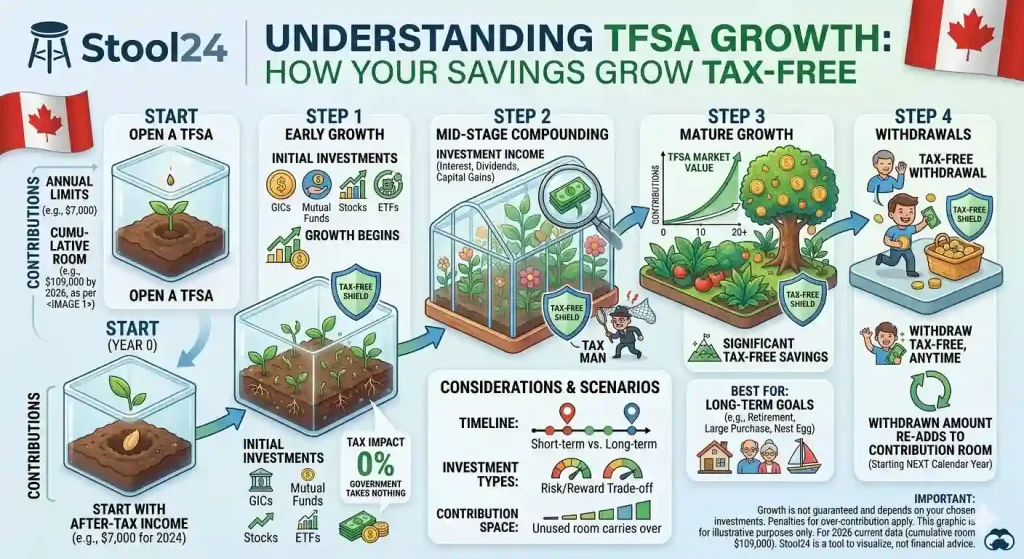
A Tax Free Savings Account (TFSA) is a registered investment account that allows Canadians aged 18 and older to save and invest money without paying tax on earnings. Contributions are made with after-tax dollars, but any growth inside the account is fully tax-free. This makes the TFSA a highly flexible and powerful tool for both short-term savings and long-term wealth accumulation.
Definition of a Tax Free Savings Account
A TFSA is a government-approved account designed to let your investments grow without taxation. You can hold cash, GICs, ETFs, stocks, and mutual funds inside the account, and all growth is sheltered from income tax. This includes interest earned, dividends received, and capital gains realized.
Who Can Open a TFSA in Canada
Any Canadian resident aged 18 or older with a valid Social Insurance Number (SIN) is eligible to open a TFSA. You can have multiple TFSA accounts across different financial institutions, but your total contributions must not exceed your annual and accumulated limits.
Why the TFSA Is One of Canada’s Most Powerful Investment Accounts
Unlike RRSPs, TFSA withdrawals do not affect government benefits such as the Canada Child Benefit or Old Age Security. Plus, the flexibility to withdraw and recontribute without tax penalties allows Canadians to use the TFSA for emergencies, major purchases, or long-term growth.
How TFSA Growth Works (Tax Free Savings Account Rules Explained)
Understanding how your TFSA grows is crucial to making the most of it. Growth can come from interest, dividends, or capital gains, and all of it is completely tax-free.
What “Tax-Free Growth” Really Means
Any investment income inside a TFSA is sheltered from taxes. For example, if your stocks generate $1,000 in dividends or capital gains in a year, you keep the entire amount. This allows your investments to compound faster than they would in a taxable account.
How Compound Growth Works Inside a TFSA
Compound growth allows your earnings to generate their own earnings. For instance, contributing $7,000 annually and earning 6% returns could grow to over $250,000 in 20 years. Use our TFSA Growth Calculator to see exactly how your contributions can grow over time. Try it here.
Why TFSA Growth Is More Powerful Than Taxable Accounts
In a taxable account, investment growth is reduced by annual taxes on dividends and interest, and capital gains are taxed when realized. A TFSA eliminates this drag on growth entirely, which can result in tens of thousands of dollars more over the long term.
Below is a table showing a comparison between TFSA and taxable accounts.
| Feature | TFSA | Taxable Account |
|---|---|---|
| Taxes on Growth | 0% | Annual tax on interest/dividends |
| Capital Gains | Tax-free | Taxable when realized |
| Withdrawal Flexibility | Anytime, tax-free | May trigger taxes |
TFSA Contribution Rules Every Canadian Should Know
Knowing your contribution limits is critical to avoid penalties and optimize growth.
Annual TFSA Contribution Limits
Canada sets annual contribution limits, which have increased over time. From 2009 to 2026, the annual limits have ranged from $5,000 to $6,500, allowing Canadians to accumulate a significant amount over the years.
How TFSA Contribution Room Works
Unused contribution room carries forward indefinitely. For example, if you contribute $3,000 of a $6,500 limit in one year, the remaining $3,500 is added to next year’s allowance.
What Happens If You Over-Contribute
Over-contributions are subject to a 1% monthly penalty on the excess amount. Always track your contributions carefully to avoid unnecessary charges.
How Withdrawals Affect TFSA Growth and Contribution Room
Many Canadians are unclear on how withdrawals interact with contribution room and growth.
Are TFSA Withdrawals Really Tax Free?
Yes. Withdrawals from a TFSA do not trigger taxes and do not affect government benefits. This flexibility makes the TFSA ideal for both emergencies and planned expenses.
How Withdrawals Restore Contribution Room
Withdrawn amounts are added back to your contribution room in the following year. For instance, if you withdraw $5,000 in 2026, you can recontribute that $5,000 in 2027 in addition to the annual limit.
Common Withdrawal Mistakes Canadians Make
Frequent or poorly timed withdrawals can limit growth. Avoid withdrawing money unless necessary to maximize the benefits of compounding.
Best Investments for Maximizing TFSA Growth
Choosing the right investments is key to leveraging your TFSA’s tax-free advantage.
Stocks vs ETFs vs GICs in a TFSA
- Stocks: Higher potential growth, higher risk
- ETFs: Diversified, moderate risk
- GICs: Safe, but low growth
Why High-Growth Investments Work Best in TFSA
Because all growth is tax-free, investing in higher-growth assets maximizes compounding. This is particularly effective over 10–20 year horizons.
Example Portfolio Allocation for Long-Term Growth
- 60% equity ETFs
- 20% Canadian stocks
- 20% fixed income or GICs
TFSA vs RRSP: Which Grows Your Money Faster?
Comparing TFSA and RRSP growth is essential for financial planning. Both accounts offer tax advantages, but in different ways.
Key Differences Between TFSA and RRSP
RRSP contributions are tax-deductible, but withdrawals are taxed. TFSA contributions are not deductible, but growth and withdrawals are tax-free.
Tax Treatment Comparison
Use this table to see which account works better depending on your income and long-term plans.
| Feature | TFSA | RRSP |
|---|---|---|
| Tax on Contributions | After-tax dollars | Tax-deductible |
| Tax on Growth | 0% | Deferred until withdrawal |
| Withdrawal Flexibility | Anytime, tax-free | Taxed, penalties if early |
Learn more about the differences in our TFSA vs RRSP comparison guide.
When TFSA Is the Better Choice
For low- to mid-income earners or for flexible, long-term growth, TFSAs often outperform RRSPs due to tax-free compounding and unrestricted withdrawals.
Common TFSA Mistakes That Limit Growth
Even small errors can cost you thousands over time.
- Over-contributing: Triggers penalties and reduces net growth
- Holding low-growth assets: Misses out on compounding advantage
- Frequent withdrawals: Reduces long-term growth potential
- Ignoring unused contribution room: Leaves money on the table
Real Example: How a TFSA Can Grow Over 25 Years
Understanding potential long-term growth helps illustrate the benefits of tax-free compounding.
This table shows a $7,000 annual contribution growing at 6% over 25 years:
| Year | Contributions | Growth | Total Value |
|---|---|---|---|
| 1 | $7,000 | $420 | $7,420 |
| 5 | $35,000 | $10,800 | $45,800 |
| 10 | $70,000 | $30,600 | $100,600 |
| 25 | $175,000 | $124,800 | $299,800 |
How Tax-Free Compounding Accelerates Wealth
Unlike taxable accounts, each year’s earnings in a TFSA are reinvested fully, leading to exponential growth. This is particularly powerful over decades, especially when starting early.
What Happens if the Investments Perform Better
Higher-than-expected returns amplify the effect of compounding. This is why many experts recommend using TFSAs for high-growth assets, as even small annual improvements significantly increase long-term wealth.
Expert Tips to Maximize TFSA Growth
- Contribute early in the year: Maximizes compounding period
- Reinvest dividends automatically: Avoids idle cash
- Focus on long-term investing: Resist short-term withdrawals
- Use TFSA for high-growth assets: Take full advantage of tax-free compounding
Explore additional tax and investment tools with our comprehensive Tax Toolkit to optimize your TFSA strategy.
FAQS For TFSA Growth Works
What is the maximum amount I can contribute to a TFSA in Canada?
The annual TFSA contribution limit for 2026 is $6,500. Unused contribution room from previous years carries forward indefinitely, so you can contribute more if you haven’t used your full limit in prior years.
How does TFSA growth work?
TFSA growth occurs through interest, dividends, and capital gains on investments held inside the account. All growth is tax-free, which means your earnings compound faster compared to taxable accounts.
Are TFSA withdrawals taxable?
No, withdrawals from a TFSA are completely tax-free and do not affect your government benefits. The withdrawn amount is added back to your contribution room in the following year.
What happens if I over-contribute to my TFSA?
Over-contributions are subject to a 1% monthly penalty on the excess amount. It’s important to track your contributions carefully to avoid unnecessary charges.
Which investments grow best in a TFSA?
High-growth investments such as stocks, equity ETFs, and diversified mutual funds are ideal for TFSAs. Because growth is tax-free, these investments benefit the most from compounding over the long term.
Can I lose money in my TFSA?
Yes, investments in a TFSA can lose value depending on market performance. It’s important to choose assets aligned with your risk tolerance and long-term goals.
How does TFSA compare to an RRSP for growth?
TFSAs offer tax-free growth and flexible withdrawals, while RRSPs provide tax deductions upfront but taxed withdrawals later. For many Canadians, TFSAs may outperform RRSPs when considering long-term compounding and withdrawal flexibility.
Quick Summary
The TFSA is one of Canada’s most powerful tools for growing wealth tax-free. By understanding contribution limits, withdrawal rules, and investment options, Canadians can maximize long-term growth. Avoid common mistakes, choose growth-oriented investments, and take advantage of compounding to make your TFSA work harder. For detailed growth projections, use our TFSA Growth Calculator and plan strategically today. Try it here.
{ “@context”: “https://schema.org”, “@type”: “FAQPage”, “mainEntity”: [ { “@type”: “Question”, “name”: “What is the maximum amount I can contribute to a TFSA in Canada?”, “acceptedAnswer”: { “@type”: “Answer”, “text”: “The annual TFSA contribution limit for 2026 is $6,500. Unused contribution room from previous years carries forward indefinitely, so you can contribute more if you haven’t used your full limit in prior years.” } }, { “@type”: “Question”, “name”: “How does TFSA growth work?”, “acceptedAnswer”: { “@type”: “Answer”, “text”: “TFSA growth occurs through interest, dividends, and capital gains on investments held inside the account. All growth is tax-free, which means your earnings compound faster compared to taxable accounts.” } }, { “@type”: “Question”, “name”: “Are TFSA withdrawals taxable?”, “acceptedAnswer”: { “@type”: “Answer”, “text”: “No, withdrawals from a TFSA are completely tax-free and do not affect your government benefits. The withdrawn amount is added back to your contribution room in the following year.” } }, { “@type”: “Question”, “name”: “What happens if I over-contribute to my TFSA?”, “acceptedAnswer”: { “@type”: “Answer”, “text”: “Over-contributions are subject to a 1% monthly penalty on the excess amount. It’s important to track your contributions carefully to avoid unnecessary charges.” } }, { “@type”: “Question”, “name”: “Which investments grow best in a TFSA?”, “acceptedAnswer”: { “@type”: “Answer”, “text”: “High-growth investments such as stocks, equity ETFs, and diversified mutual funds are ideal for TFSAs. Because growth is tax-free, these investments benefit the most from compounding over the long term.” } }, { “@type”: “Question”, “name”: “Can I lose money in my TFSA?”, “acceptedAnswer”: { “@type”: “Answer”, “text”: “Yes, investments in a TFSA can lose value depending on market performance. It’s important to choose assets aligned with your risk tolerance and long-term goals.” } }, { “@type”: “Question”, “name”: “How does TFSA compare to an RRSP for growth?”, “acceptedAnswer”: { “@type”: “Answer”, “text”: “TFSAs offer tax-free growth and flexible withdrawals, while RRSPs provide tax deductions upfront but taxed withdrawals later. For many Canadians, TFSAs may outperform RRSPs when considering long-term compounding and withdrawal flexibility.” } } ] }