
A bakery owner in Toronto wants to expand to a second location. The opportunity is there, but the equipment, renovation, and staffing costs quickly add up. Before approaching a bank, the owner needs to understand the small business loan requirements Canada lenders typically expect.
Knowing those requirements can make the difference between approval and rejection. Canadian lenders evaluate credit history, revenue stability, documents, and the overall financial health of a business. In this guide, you’ll learn what lenders actually look for, which documents you’ll need, and how to prepare a strong loan application that improves your chances of approval.
Table of Contents
Small Business Loan Requirements Canada Eligibility, Documents, and Approval Guide
Applying for business financing in Canada isn’t just about asking for money. Lenders want proof that a company can repay the loan responsibly. Understanding the requirements ahead of time allows business owners to prepare stronger applications and avoid delays during the review process.
Whether you’re applying through a major bank, an online lender, or a government-backed program, the evaluation process usually follows the same basic criteria. Let’s break down what lenders examine before approving funding.
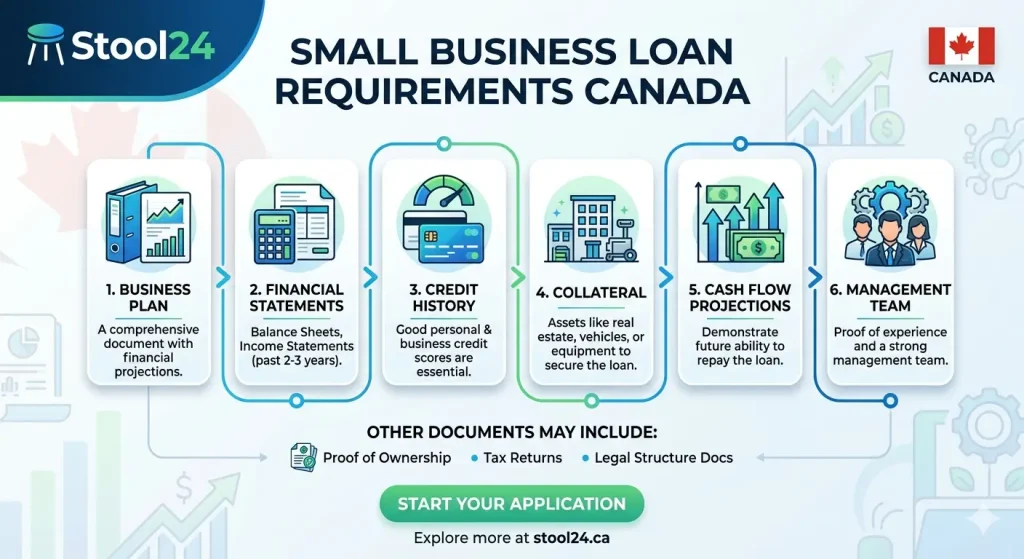
Understanding Small Business Loan Requirements in Canada
Most Canadian lenders follow a structured approval process designed to measure risk. They evaluate the stability of your business, your financial history, and the ability of your company to repay borrowed funds.
Financial institutions like the Business Development Bank of Canada report that access to financing remains one of the biggest challenges for growing businesses. That’s why lenders rely on several benchmarks before approving a loan.
What Lenders Look for Before Approving a Business Loan
Before approving funding, lenders typically analyze four main factors:
- Business revenue and cash flow stability
- Owner’s personal and business credit score
- Existing debt obligations
- Overall business plan and growth potential
A company with stable revenue and organized financial records usually moves through the approval process faster.
Types of Small Business Loans Available in Canada
Not every loan works the same way. Canadian businesses can access several financing options depending on their needs.
- Term loans for expansion or equipment
- Business lines of credit for working capital
- Equipment financing
- Government-backed loans
- Startup loans for new businesses
Each option has slightly different eligibility requirements and documentation expectations.
Bank Loans vs Online Lenders: Key Requirement Differences
Traditional banks often require stronger financial history and higher credit scores. Online lenders, on the other hand, tend to approve loans faster but may charge higher interest rates.
This comparison shows how requirements often differ.
Comparison of Typical Canadian Business Loan Requirements
| Lender Type | Credit Score | Revenue Requirement | Collateral | Approval Speed |
|---|---|---|---|---|
| Major Banks | 680+ | Established revenue | Often required | 2–6 weeks |
| Online Lenders | 600+ | Moderate revenue | Sometimes optional | 1–7 days |
| Government Programs | Varies | Business plan required | Limited | Several weeks |
Choosing the right lender depends on your business stage and financing needs.
Common Eligibility Criteria for Small Business Loans in Canada
Many business owners ask the same question: what exactly qualifies a company for financing? While criteria vary slightly between lenders, several core eligibility requirements apply across most Canadian financial institutions.
Minimum Credit Score Requirements
Your credit score plays a major role in loan approval. Most banks expect a personal credit score of at least 680 for traditional business loans.
Alternative lenders may accept scores closer to 600. However, lower scores usually result in higher interest rates or smaller loan amounts.
According to the Government of Canada business funding resources, maintaining strong credit history significantly improves financing options for entrepreneurs.
Business Age and Operating History
Lenders often prefer businesses that have been operating for at least one to two years. This history provides evidence of revenue patterns and financial stability.
Startups without operating history may still qualify for specialized programs or government-supported loans.
Revenue and Cash Flow Expectations
Most lenders require proof that your company generates enough income to repay the loan. Monthly revenue benchmarks vary, but many lenders expect businesses to earn at least $10,000 per month before considering larger loans.
This requirement helps reduce lending risk.
Collateral and Personal Guarantee Requirements
Collateral acts as security for the lender. If a borrower cannot repay the loan, the lender can recover funds through the pledged asset.
Common collateral examples include:
- Business equipment
- Commercial property
- Inventory
- Personal guarantees from the owner
Government programs sometimes reduce collateral requirements to make financing more accessible.
Documents Required for a Small Business Loan Application
Preparing the right documents early can significantly speed up the approval process. Most lenders ask for financial records that demonstrate the health of your business.
Basic Business Documentation
These documents verify that your company operates legally and is registered in Canada.
- Business registration documents
- Articles of incorporation
- Business licenses
- Partnership agreements (if applicable)
Financial Statements and Tax Returns
Lenders review financial statements to understand how your company performs.
- Balance sheets
- Income statements
- Cash flow statements
- Two to three years of tax returns
Using financial planning tools from the tax toolkit can help business owners organize these records before applying for funding.
Business Plan and Revenue Projections
For newer companies, a clear business plan is essential. Lenders want to see how the borrowed funds will be used and how the business expects to grow.
A good plan usually includes market research, pricing strategy, and projected financial results for the next two to three years.
Personal Financial Information
Even though the loan supports a business, lenders often review the owner’s personal financial situation.
- Personal credit report
- Debt obligations
- Personal income verification
This helps lenders evaluate the overall financial reliability of the borrower.
Small Business Loan Requirements Canada for Different Loan Types
Loan requirements can change depending on the financing program you choose. Some lenders emphasize credit scores, while others focus on revenue potential.
Bank Business Loans
Major banks such as Royal Bank of Canada or TD often require:
- Strong credit history
- At least two years of business operations
- Detailed financial statements
- Collateral or guarantees
These loans usually offer the lowest interest rates but involve longer approval timelines.
Government-Backed Loans
Programs such as the Canada Small Business Financing Program help businesses access funding with lower risk to lenders.
These programs are supported by federal policies and are designed to encourage entrepreneurship across the country.
Startup Loans and New Business Financing
Startups face a tougher path because they lack financial history. Organizations like Futurpreneur Canada provide loans and mentorship for young entrepreneurs starting new ventures.
Approval often depends on the strength of the business plan rather than historical revenue.
Online and Alternative Lenders
Online lenders provide faster approvals and simplified applications. Many businesses use them for short-term working capital or inventory financing.
The trade-off usually involves higher interest rates compared with traditional bank loans.
Step-by-Step Process to Apply for a Small Business Loan in Canada
Applying for financing becomes much easier when you follow a structured process.
Step 1: Determine the Amount of Financing Needed
Calculate how much capital your business truly requires. Overestimating can make lenders cautious, while requesting too little may not solve the problem.
Estimating monthly payments helps you understand the affordability of a loan.
If you’re planning financing, a quick calculation can help estimate monthly payments and borrowing capacity.
[ Calculate Monthly Payments ]
Loan calculator
Step 2: Prepare Your Financial Documents
Gather financial statements, tax records, and your business plan before approaching lenders. Organized documentation speeds up the review process.
Step 3: Compare Canadian Lenders
Different lenders offer different loan structures, interest rates, and approval criteria.
You can compare lenders and financing options through guides like Canadian loan lenders comparison before submitting an application.
Step 4: Submit the Loan Application
Most lenders now allow online applications. After submission, the lender reviews documents, performs credit checks, and evaluates risk.
Step 5: Loan Review and Approval Timeline
Approval time depends on the lender type. Banks may take several weeks, while online lenders often provide decisions within days.
How to Increase Your Chances of Loan Approval
Many rejected applications share the same weaknesses. Preparing strategically can significantly increase approval odds.
Improve Your Business Credit Profile
Pay bills on time and reduce existing debt before applying. Even small improvements in credit scores can affect lender decisions.
Strengthen Cash Flow and Financial Records
Consistent revenue and accurate accounting show lenders that the business is financially stable.
Offer Collateral or Guarantees
Providing collateral lowers the lender’s risk. This often leads to better interest rates and higher loan limits.
Build a Strong Business Plan
A detailed plan demonstrates how the loan will generate revenue and support long-term growth.
Clear financial projections help lenders visualize repayment capacity.
Common Mistakes That Lead to Business Loan Rejections
Even profitable companies can face rejection if their applications contain critical weaknesses.
Applying Without Proper Documentation
Incomplete records slow the review process and raise concerns about financial organization.
Poor Credit History
Late payments or high debt ratios reduce lender confidence.
Unclear Business Revenue Model
Lenders want to understand how a company generates income. A vague or inconsistent revenue model often leads to rejection.
Requesting Unrealistic Loan Amounts
Borrowing far more than the business can realistically repay raises red flags during evaluation.
FAQS For Small Business Loan Requirements Canada
What credit score is required for a small business loan in Canada?
Most Canadian banks prefer a personal credit score of around 680 or higher for traditional small business loans. Alternative or online lenders may approve loans with scores closer to 600, but interest rates are usually higher. A stronger credit profile improves approval chances and loan terms.
Can a startup get a small business loan in Canada?
Yes, startups can access financing, although the requirements are different. Lenders often focus more on a detailed business plan, industry experience, and revenue projections. Programs like Futurpreneur Canada and certain government-backed loans specifically support new businesses.
What documents are required for a small business loan application in Canada?
Typical documents include business registration papers, financial statements, tax returns, and a detailed business plan. Lenders may also request personal financial information and credit reports from the business owner. Preparing these documents in advance can significantly speed up the approval process.
Do you need collateral for a small business loan in Canada?
Many traditional lenders require collateral such as equipment, property, or inventory to secure a loan. However, some government programs and online lenders offer financing with reduced collateral requirements. Providing collateral can help secure lower interest rates and larger loan amounts.
How much revenue do you need to qualify for a business loan?
Revenue requirements vary depending on the lender and loan type. Many Canadian lenders prefer businesses generating at least $8,000–$10,000 in monthly revenue before approving financing. Strong and consistent cash flow helps demonstrate the ability to repay the loan.
How long does it take to get approved for a business loan in Canada?
Approval times vary widely depending on the lender. Traditional banks may take two to six weeks to complete the evaluation process, while online lenders often provide decisions within a few days. Preparing financial documents ahead of time can help shorten the timeline.
Are there government small business loan programs in Canada?
Yes, Canada offers several government-supported financing programs designed to help small businesses grow. One well-known option is the Canada Small Business Financing Program, which helps businesses access funding through participating lenders. These programs often offer lower risk and more flexible lending conditions.
Quick Summary
Understanding the small business loan requirements Canada lenders expect can dramatically improve your chances of approval. Most lenders evaluate credit score, revenue stability, financial documentation, and overall business planning before approving funding.
Preparing financial records, comparing lenders, and presenting a clear growth strategy can make a significant difference during the application process. With the right preparation, Canadian entrepreneurs can access the financing needed to grow, expand, and compete in a rapidly evolving business environment.