
A pay raise or a year-end bonus often brings a quick question: how much tax will actually be taken from that extra income? Canada’s progressive tax system means different portions of your income are taxed at different rates. That’s where the concept of marginal tax rate canada explained becomes important. Your marginal rate determines how much tax applies to the next dollar you earn.
Understanding this concept helps you make smarter financial decisions—whether you’re planning RRSP contributions, estimating a bonus payout, or simply trying to understand your paycheque. In this guide, you’ll learn how marginal tax rates work in Canada, how federal and provincial taxes combine, and how to use that knowledge to manage your taxes more effectively.
Table of Contents
Marginal Tax Rate Canada Explained How Tax Brackets Really Work
Canada uses a progressive tax system. That means your income is divided into layers called tax brackets. Each layer is taxed at a different rate, and only the income within that bracket is taxed at that level.
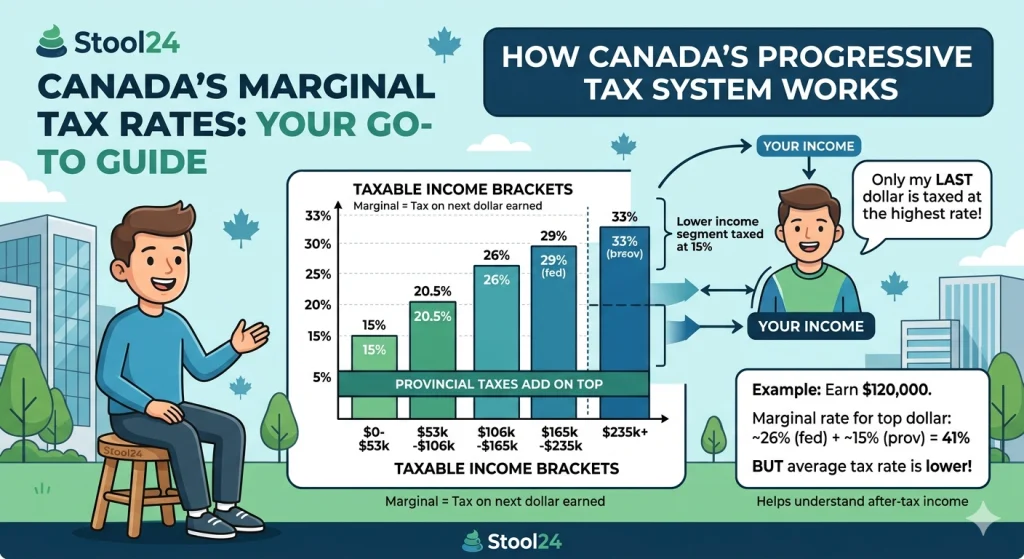
When people search for marginal tax rate canada explained, they usually want to know one thing: does moving to a higher tax bracket increase tax on all income? The short answer is no. Only the portion above the threshold is taxed at the higher rate.
What a Marginal Tax Rate Means in Canada
Your marginal tax rate refers to the percentage of tax applied to the next dollar you earn. It is not the overall tax rate on your total income. Instead, it reflects the highest bracket your income reaches.
What Is a Marginal Tax Rate?
A marginal tax rate is simply the tax rate applied to additional income. If you earn extra income through a raise, overtime, or investments, that income is taxed according to the bracket it falls into.
For example, if your marginal rate is 30%, every additional dollar you earn is taxed at roughly 30 cents. Your overall tax rate, however, will usually be lower because earlier portions of income were taxed at lower rates.
How Canada’s Progressive Tax System Works
The Canadian tax system applies several brackets to taxable income. Lower portions of income are taxed at lower rates, and higher portions are taxed at higher rates.
This structure ensures that higher earners pay more tax proportionally, while basic income levels remain taxed at lower rates.
Why Only Part of Your Income Is Taxed at Each Rate
A common misunderstanding is that entering a new bracket means all income is taxed at that rate. In reality, the system works step by step.
Income fills one bracket first, then moves to the next. This tiered approach is why understanding marginal rates is so important for tax planning.
Canadian Tax Brackets and Marginal Rates
Tax rates in Canada come from two sources: federal tax and provincial tax. Each level of government applies its own brackets, and the combined rate determines your final marginal tax rate.
Federal Income Tax Brackets
The table below shows a simplified example of federal income tax brackets.
Example Federal Income Tax Brackets
| Income Range | Federal Tax Rate |
|---|---|
| Up to $55,867 | 15% |
| $55,867 – $111,733 | 20.5% |
| $111,733 – $173,205 | 26% |
| $173,205 – $246,752 | 29% |
| Over $246,752 | 33% |
These rates are set by the federal government and updated periodically. Official details are published by the Canada Revenue Agency.
Provincial Tax Brackets and How They Differ
Each province applies additional tax brackets. Ontario, British Columbia, and Alberta all have different rates and thresholds.
This means two Canadians earning the same salary may pay different taxes depending on where they live.
How Federal and Provincial Marginal Tax Rates Combine
Your total marginal tax rate is the combination of federal and provincial taxes.
To better understand the relationship between the two systems, see this detailed guide on federal vs provincial tax canada, which explains how both levels of taxation interact.
Marginal Tax Rate Canada Explained With Simple Examples
Understanding marginal rates becomes easier when you look at practical scenarios.
Example 1: Middle-Income Salary Scenario
Imagine a worker earning $70,000 per year in taxable income. Part of that income falls into the first federal bracket and part into the second.
The first portion is taxed at 15%, while income above the first threshold moves into the 20.5% bracket.
The overall tax rate on the entire income is therefore lower than 20.5%.
Example 2: Higher-Income Earner
Someone earning $120,000 will pass through three federal brackets. Each layer is taxed at progressively higher rates.
Only the income above the third bracket threshold faces the highest marginal rate.
Example 3: Extra Income From a Bonus or Overtime
Bonuses and overtime are often taxed at a higher rate because they sit on top of existing income.
This doesn’t mean the government is taking most of your bonus. It simply means that extra income falls into a higher marginal bracket.
Step-by-Step Tax Calculation
A simplified example calculation may look like this:
- First portion taxed at 15%
- Next portion taxed at 20.5%
- Remaining portion taxed at 26%
Each step applies only to the income inside that bracket.
Marginal Tax Rate vs Average Tax Rate
Another important question readers ask is how marginal tax rates differ from average or effective tax rates.
The table below compares the two concepts.
Marginal vs Average Tax Rate Comparison
| Feature | Marginal Tax Rate | Average Tax Rate |
|---|---|---|
| Definition | Tax on the next dollar earned | Total tax divided by total income |
| Purpose | Used for tax planning | Shows overall tax burden |
| Impact | Affects bonuses and extra income | Reflects total taxes paid |
Financial planners often focus on marginal rates when advising clients about RRSP contributions and investment strategies.
According to the Department of Finance Canada, progressive taxation helps balance government revenue while protecting lower-income households.
How Marginal Tax Rates Affect Financial Decisions
Once you understand marginal rates, you can use them to make smarter financial choices throughout the year.
RRSP Contributions and Tax Savings
RRSP contributions reduce taxable income. If a deduction pushes your income into a lower bracket, your marginal tax rate drops.
This strategy is widely used by higher-income earners to reduce their tax burden.
Bonuses, Side Income, and Overtime
Extra income often lands in a higher tax bracket, but that doesn’t mean it isn’t worth earning.
The key is planning ahead so you understand the after-tax value of additional earnings.
Investment Income and Tax Planning
Investment income, dividends, and capital gains are taxed differently. However, your marginal tax bracket still influences the total tax paid.
Many financial planners recommend tracking your expected taxable income before the end of the year.
Use the Canada Income Tax Calculator
Common Misconceptions About Canadian Tax Brackets
Misunderstanding marginal tax rates leads to many myths about taxation.
Myth: Entering a Higher Bracket Taxes All Income
This is the most common misunderstanding. Only the portion above the threshold is taxed at the higher rate.
Myth: Higher Income Always Means Much Higher Taxes
While taxes do increase with income, the progressive system prevents sudden jumps in total tax liability.
Why Understanding Marginal Rates Prevents Tax Confusion
Once you see how income moves gradually through brackets, tax calculations become easier to understand.
It also becomes clearer why raises and bonuses are usually beneficial, even if they move you into a higher bracket.
Expert Tips to Manage Your Marginal Tax Rate
Tax planning strategies can help reduce how much of your income falls into the highest brackets.
- Contribute to RRSPs to reduce taxable income
- Track income increases during the year
- Plan bonus timing when possible
- Use tax calculators to estimate your marginal rate
Financial platforms such as Wealthsimple and H&R Block Canada often recommend reviewing your marginal tax rate before making large financial decisions.
FAQS For Marginal Tax Rate Canada Explained
What is the marginal tax rate in Canada?
The marginal tax rate in Canada is the percentage of tax applied to the next dollar you earn. Because Canada uses a progressive tax system, different portions of your income fall into different tax brackets. Your marginal rate is simply the highest bracket your income reaches.
Does moving into a higher tax bracket mean all my income is taxed more?
No, only the income above the new tax bracket threshold is taxed at the higher rate. The income within lower brackets continues to be taxed at the lower rates. This tiered structure prevents sudden jumps in total taxes when your income increases.
How are federal and provincial marginal tax rates combined?
Canadian taxpayers pay both federal and provincial income taxes. Each level of government applies its own tax brackets, and the combined rates determine your total marginal tax rate. The exact rate varies depending on the province or territory where you live.
What is the difference between marginal tax rate and average tax rate?
The marginal tax rate applies to the next dollar you earn, while the average tax rate represents the total tax you pay divided by your total income. Because lower portions of income are taxed at lower rates, the average rate is usually lower than the marginal rate.
How can I reduce my marginal tax rate in Canada?
You can reduce your marginal tax rate by lowering your taxable income through deductions and credits. Common strategies include contributing to an RRSP, claiming eligible tax credits, or timing certain income or deductions within the tax year.
Why is the marginal tax rate important for financial planning?
Your marginal tax rate helps estimate how much tax will apply to additional income such as bonuses, overtime, or investment earnings. Understanding this rate allows you to plan RRSP contributions, calculate after-tax income, and make better financial decisions.
Where can I calculate my marginal tax rate in Canada?
You can estimate your marginal tax rate using online tax calculators designed for Canadian income taxes. These tools combine federal and provincial brackets to give a realistic estimate based on your income and location.
Quick Summary
The phrase marginal tax rate canada explained refers to understanding how Canada’s progressive tax system applies different rates to different income levels. Only the income within each bracket is taxed at that bracket’s rate.
Your marginal rate affects extra income like bonuses, side earnings, and investment gains. By understanding how federal and provincial taxes combine—and by using tools like tax calculators—you can make better financial decisions and manage your taxes more effectively throughout the year.