
You’re reviewing a rental property priced at $480,000, generating steady monthly rent. On paper, it looks like a solid deal—but how do you know if it actually delivers a good return? This is where the cap rate formula explained becomes essential. It gives you a quick way to measure profitability using real numbers, not assumptions.
In this guide, you’ll learn how cap rate works, how to calculate it step by step, and how to apply it in Canadian real estate markets. You’ll also discover practical examples, expert insights, and common mistakes so you can evaluate properties with confidence.
Table of Contents
Cap Rate Formula Explained (With Canadian Real Estate Examples)
What Is Cap Rate in Real Estate?
Cap rate, short for capitalization rate, is a simple metric used to estimate the return on a rental property. It compares the income a property generates to its market value.
Instead of guessing, investors use cap rate to quickly compare different properties. Whether you’re investing in Toronto or Calgary, it helps you see which deal offers better income potential.
Why Cap Rate Matters for Property Investors
Cap rate answers a practical question: how much income will this property produce relative to its price? This makes it easier to screen deals before doing deeper analysis.
Cap Rate vs Property Value Relationship
As property prices increase, cap rates often decrease if rental income doesn’t rise at the same pace. That’s why expensive markets usually have lower cap rates.
When Cap Rate Is Most Useful
Cap rate works best when comparing similar properties in the same area. It’s particularly useful for rental and commercial investments with consistent income.
Cap Rate Formula Explained (Step-by-Step)
Understanding the cap rate formula explained clearly helps you apply it without confusion. Once you know the components, it becomes very easy to calculate.
The Cap Rate Formula Explained Clearly
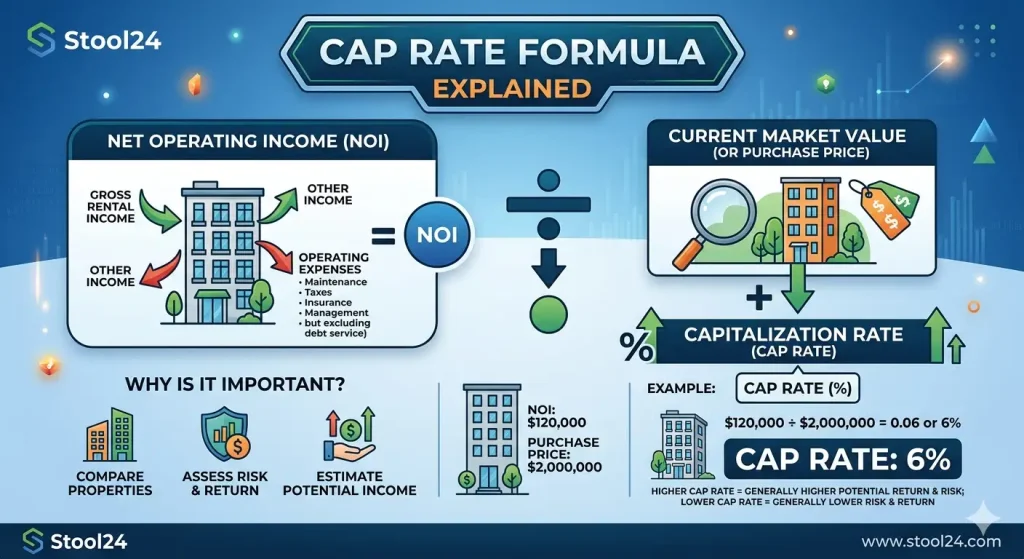
Cap Rate = Net Operating Income (NOI) ÷ Property Value
This gives you a percentage return before mortgage and taxes are considered.
What Is Net Operating Income (NOI)?
NOI is the income left after subtracting operating expenses from rental income. It reflects how much the property actually earns.
What Expenses Are Included in NOI?
- Property taxes
- Insurance
- Maintenance and repairs
- Property management fees
What Is NOT Included in NOI?
- Mortgage payments
- Income taxes
- Major capital upgrades
How to Calculate Cap Rate (With Real Examples)
Let’s walk through a practical example so you can see how the numbers come together.
Simple Cap Rate Calculation Example
If a property generates $28,000 annually and costs $400,000, the cap rate is 7%. This gives a quick snapshot of return potential.
Real Canadian Property Example
In Toronto, a $700,000 property might bring in $30,000 annually. After $10,000 in expenses, the NOI is $20,000—resulting in a cap rate of about 2.85%.
Step-by-Step Calculation Guide
- Estimate annual rental income
- Subtract operating expenses
- Divide NOI by property price
Cap Rate Calculation Table (Visual Breakdown)
This table shows how income and expenses impact cap rate.
| Property Price | Annual Income | Expenses | NOI | Cap Rate |
|---|---|---|---|---|
| $400,000 | $30,000 | $10,000 | $20,000 | 5% |
| $500,000 | $32,000 | $12,000 | $20,000 | 4% |
A quick estimate can be done in seconds.
Instead of manual calculations, you can instantly evaluate deals by entering income, expenses, and price into a calculator.
[ Calculate Rental Property Returns Now ]
You can also compare multiple properties using a rental yield calculator to get a clearer picture of income performance.
What Is a Good Cap Rate in Canada?
A good cap rate depends on location, property type, and risk tolerance. In major cities, lower cap rates are common due to higher property prices.
Average Cap Rates by Canadian Cities
This table shows typical cap rate ranges across Canadian markets.
| City | Cap Rate Range |
|---|---|
| Toronto | 2% – 4% |
| Vancouver | 2% – 3.5% |
| Calgary | 4% – 6% |
According to Canada Mortgage and Housing Corporation, strong housing demand in major cities continues to compress cap rates as property values rise faster than rental income.
High vs Low Cap Rate Explained
Higher cap rates often mean higher returns but come with increased risk. Lower cap rates usually reflect stable markets with strong demand.
Risk vs Return Trade-Off
Investors must balance income potential with risk. Some prefer steady, lower-risk properties, while others aim for higher returns in less stable markets.
There is no perfect number.
Your ideal cap rate depends on your investment goals, whether that’s steady income or long-term appreciation.
Cap Rate vs Other Real Estate Metrics
Cap rate is useful, but it doesn’t tell the whole story. Comparing it with other metrics gives better insight.
Cap Rate vs ROI
ROI includes total returns and financing, while cap rate focuses only on property income.
Cap Rate vs Cash-on-Cash Return
This metric accounts for your actual cash investment, making it more realistic when using leverage.
Cap Rate vs Gross Rent Multiplier
Gross rent multiplier is simpler but less accurate since it ignores expenses.
This table compares key investment metrics.
| Metric | Includes Expenses | Includes Financing |
|---|---|---|
| Cap Rate | Yes | No |
| ROI | Yes | Yes |
| Cash-on-Cash | Yes | Yes |
Limitations of the Cap Rate Formula (Critical Insights)
The cap rate formula explained earlier is helpful, but it has limitations that investors should understand.
Cap Rate Ignores Financing (Mortgage Impact)
Mortgage payments can significantly affect your real returns, but cap rate does not include them.
Does Not Include Property Appreciation
Cap rate focuses only on income, not future property value growth.
Market Conditions Can Distort Cap Rate
In hot markets, rising prices can lower cap rates even if rental income is strong.
Why Investors Should Not Rely on Cap Rate Alone
Experienced investors combine cap rate with insights from Canadian Real Estate Association to understand market trends and risks.
Advanced Tips to Use Cap Rate Like a Pro
Once you understand the basics, you can use cap rate more strategically to improve decision-making.
Use Cap Rate for Property Comparison
Compare similar properties to identify undervalued opportunities.
Combine with Canadian Market Data
Use reliable data from CMHC and CREA to support your analysis.
Analyze Market Trends
Track rent growth and price changes to predict future returns.
Sensitivity Analysis (Price vs Rent Changes)
Small increases in rent or decreases in expenses can significantly improve your cap rate.
To better manage taxes and maximize returns, many investors use the tax toolkit for accurate financial planning.
Common Cap Rate Mistakes to Avoid
Even simple errors can lead to poor investment decisions. Avoid these common mistakes.
Ignoring Hidden Expenses
Unexpected costs can reduce your NOI and lower returns.
Using Unrealistic Rental Income
Overestimating rent leads to misleading calculations.
Confusing Cap Rate with Profit
Cap rate is just a quick estimate, not your final profit.
Not Adjusting for Local Market Conditions
Always consider vacancy rates, demand, and economic trends.
FAQS For Cap Rate Formula Explained
What is a good cap rate in Canada?
A good cap rate in Canada typically ranges from 2% to 6%, depending on the city and property type. Major markets like Toronto and Vancouver often have lower cap rates due to high property values, while cities like Calgary may offer higher returns.
How do you calculate cap rate step by step?
To calculate cap rate, first determine the annual rental income, then subtract operating expenses to get NOI. Finally, divide NOI by the property value to get the cap rate percentage.
Does cap rate include mortgage payments?
No, cap rate does not include mortgage payments. It focuses only on property income and operating expenses, making it a useful metric for comparing properties before financing is considered.
Is a higher cap rate always better?
Not necessarily. A higher cap rate can indicate higher returns, but it often comes with increased risk, such as lower demand or less stable rental income.
What expenses are included in NOI?
NOI includes expenses like property taxes, insurance, maintenance, and management fees. It does not include mortgage payments, income taxes, or major capital improvements.
What is the difference between cap rate and ROI?
Cap rate measures property income relative to its value, while ROI considers total return, including financing and appreciation. ROI provides a more complete picture of investment performance.
Why is cap rate important for real estate investors?
Cap rate helps investors quickly evaluate and compare rental properties based on income potential. It simplifies decision-making by providing a clear percentage return without complex calculations.
Quick Summary
The cap rate formula explained in this article gives you a fast way to evaluate real estate investments based on income. By dividing NOI by property value, you get a clear percentage return that helps compare deals quickly.
However, cap rate is only a starting point. Combine it with other metrics, real market data, and careful analysis to make smarter, more confident investment decisions.