
Planning retirement savings often starts with one key number: how much you are allowed to contribute each year. The rrsp contribution limit canada determines how much Canadians can deposit into their Registered Retirement Savings Plan while still receiving valuable tax deductions. If you contribute too little, you may miss tax savings. Contribute too much, and penalties can apply.
This guide explains the current RRSP limits, how contribution room works, and how the calculation is done. You’ll also see real examples, common mistakes, and strategies that help maximize tax savings under rules set by the Canada Revenue Agency (CRA). By the end, you’ll understand exactly how much you can contribute and how to plan your retirement savings more effectively.
Table of Contents
RRSP Contribution Limit Canada How Much You Can Contribute
The RRSP is one of the most powerful tax-advantaged savings tools available to Canadians. Contributions reduce taxable income and investments grow tax-deferred until withdrawal.
But the amount you can contribute each year is not unlimited. The federal government sets a yearly cap and a formula that determines your personal contribution room.
What Is the RRSP Contribution Limit in Canada?
The RRSP contribution limit is the maximum amount you can contribute to your retirement savings plan while claiming a tax deduction. Each person’s limit depends on earned income and any unused room from previous years.
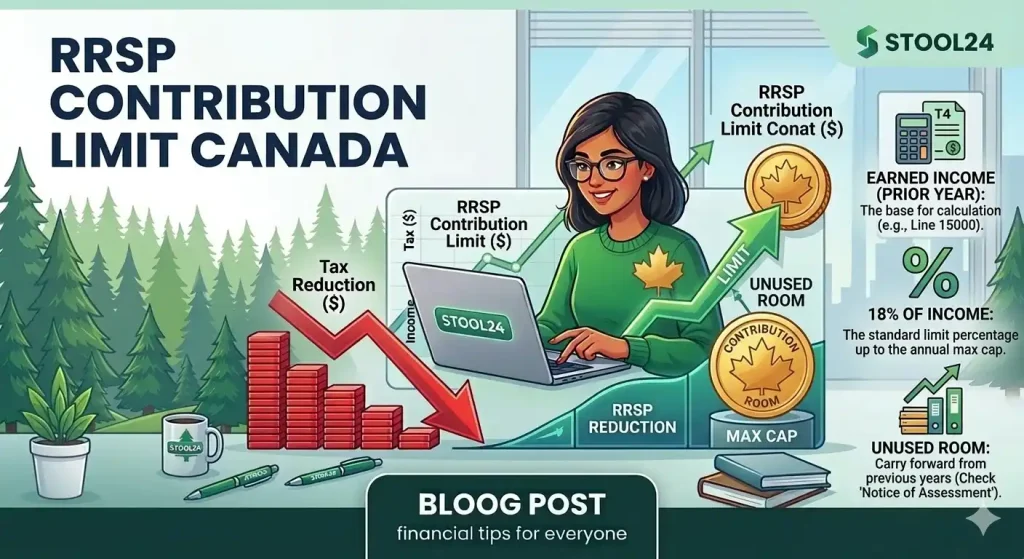
In general, the rule is simple: you can contribute 18% of your previous year’s earned income up to the annual maximum set by the federal government.
Current RRSP Annual Limits by Year
The table below shows the federal maximum RRSP limits announced by the Department of Finance Canada.
Annual RRSP Contribution Limits in Canada
| Year | Maximum RRSP Limit |
|---|---|
| 2026 | $33,810 (estimated) |
| 2025 | $32,490 |
| 2024 | $31,560 |
| 2023 | $30,780 |
These limits are indexed to inflation and usually increase each year.
Who Is Eligible to Contribute?
You can contribute to an RRSP if you meet these basic conditions:
- You earned income during the previous tax year
- You filed a tax return with the CRA
- You are under age 71
- You have available RRSP contribution room
Once you turn 71, contributions must stop, though savings can be transferred into a RRIF or annuity.
How the RRSP Contribution Limit Is Calculated
The calculation follows a formula defined by the Canada Revenue Agency. Your personal limit depends on three factors: income, pension adjustments, and unused room.
RRSP Contribution Formula
Your contribution limit is calculated using this basic formula:
- 18% of previous year earned income
- Minus pension adjustment (if you have a workplace pension)
- Plus unused contribution room from previous years
The final number appears on your Notice of Assessment after filing taxes.
What Counts as Earned Income?
The CRA considers several types of income when calculating RRSP room.
- Employment income
- Self-employment income
- Net rental income
- Business income
- Certain disability payments
Investment income such as capital gains or dividends does not create RRSP room.
How Pension Adjustment Reduces Your Limit
If you participate in an employer pension plan, your RRSP room may be reduced. This adjustment ensures that Canadians with generous workplace pensions do not receive excessive tax-deferred benefits.
The adjustment is calculated automatically and appears on your tax documents.
Understanding RRSP Contribution Room
Contribution room refers to the total amount you are allowed to contribute in a given year. It includes both the current year’s limit and any unused space carried forward.
Contribution Room vs Deduction Limit
The table below explains the difference between two terms that often confuse taxpayers.
RRSP Contribution Room vs Deduction Limit
| Term | Meaning |
|---|---|
| Contribution Room | Total amount you are allowed to deposit into your RRSP |
| Deduction Limit | Amount you can claim as a tax deduction for the current year |
You can contribute this year but choose to claim the deduction later if it benefits your tax planning.
Unused Contribution Room Carries Forward
One major advantage of RRSPs is flexibility. If you do not use your full contribution limit in a given year, the remaining room carries forward indefinitely.
According to data published by the Canada Revenue Agency, Canadians collectively hold hundreds of billions of dollars in unused RRSP contribution room.
How to Check Your RRSP Contribution Room
You can verify your personal limit using several methods:
- Review your CRA Notice of Assessment
- Log into CRA My Account online
- Check tax software records from your latest return
These sources provide the most accurate numbers for your RRSP contribution limit.
Need a quick estimate?
If you want to quickly estimate your potential tax savings, try using a calculator.
Calculate Your RRSP Contribution Now
Example: Calculating RRSP Contribution Limits
Seeing real examples makes the rules easier to understand. The amount you can contribute depends heavily on income.
Example With $60,000 Income
If you earned $60,000 last year:
- 18% of $60,000 = $10,800
- No pension adjustment
- No unused room
Your RRSP contribution limit would be $10,800.
Example With $100,000 Income
If your income was $100,000, the formula would give $18,000 of potential room. However, the annual federal cap may apply if your income is high enough.
This rule ensures contribution benefits remain balanced across income levels.
RRSP Contribution Deadline and Rules
RRSP contributions do not follow the standard calendar year. Instead, the government allows an additional contribution period early in the following year.
RRSP Contribution Deadline
The typical contribution deadline falls in early March for the previous tax year. Contributions made before the deadline can still reduce last year’s taxable income.
This extended window allows Canadians to calculate taxes before deciding how much to contribute.
Age Limit for Contributions
You can contribute to an RRSP until the end of the year you turn 71. After that point, accounts must be converted to a Registered Retirement Income Fund (RRIF) or annuity.
However, contributions to a spousal RRSP may still be possible if your spouse is younger.
What Happens If You Exceed the Limit?
Overcontributing to an RRSP can trigger penalties if the excess goes beyond a small buffer allowed by the CRA.
Over-Contribution Penalty
The government allows a lifetime buffer of $2,000 above your limit.
Amounts beyond that threshold are subject to a 1% monthly penalty tax until corrected.
How to Fix an Excess Contribution
If you accidentally contribute too much, you can usually resolve the issue by withdrawing the excess or applying unused deduction room. Guidance from the Canada Revenue Agency explains the process in detail.
Smart Strategies to Maximize RRSP Contributions
Simply knowing the limit is not enough. Smart planning can increase long-term tax savings and retirement wealth.
Contribute When Your Tax Rate Is Higher
RRSP deductions provide the greatest benefit when your income tax bracket is high. Many financial planners suggest delaying deductions until income rises.
Balance RRSP and TFSA Savings
RRSP and TFSA accounts both offer tax advantages but work differently. The TFSA focuses on tax-free withdrawals while RRSPs provide immediate deductions.
A deeper explanation appears in this guide on Canadian tax systems and structures, which helps clarify how different taxes affect financial planning.
Use RRSP Programs for Major Life Goals
Two federal programs allow temporary withdrawals:
- Home Buyers’ Plan (HBP)
- Lifelong Learning Plan (LLP)
These programs allow Canadians to use retirement savings for education or home purchases while repaying the funds later.
Common RRSP Contribution Mistakes
Even experienced savers sometimes misunderstand RRSP rules. Avoiding these mistakes can protect you from penalties and lost deductions.
- Contributing without checking CRA contribution room
- Ignoring pension adjustment from employer plans
- Overcontributing beyond the $2,000 buffer
- Claiming deductions in the wrong tax year
- Forgetting unused room carries forward
For more Canadian tax resources and calculators, the Tax Toolkit provides a helpful collection of financial planning tools.
FAQS For RRSP Contribution Limit Canada
What is the RRSP contribution limit in Canada for 2025?
The maximum RRSP contribution limit for 2025 is $32,490. However, your personal limit may be lower because it is calculated as 18% of your previous year’s earned income. The final contribution room appears on your CRA Notice of Assessment.
How do I check my RRSP contribution room?
You can check your RRSP contribution room through the CRA My Account portal, your Notice of Assessment, or your latest tax return summary. These sources show both your current contribution room and your deduction limit for the tax year.
Can unused RRSP contribution room carry forward?
Yes. Any unused RRSP contribution room automatically carries forward to future years. This allows Canadians to make larger contributions later when income is higher or when they want a bigger tax deduction.
What happens if I exceed my RRSP contribution limit?
The Canada Revenue Agency allows a lifetime over-contribution buffer of $2,000. If you exceed that amount, a penalty tax of 1% per month may apply until the excess is withdrawn or adjusted.
When is the RRSP contribution deadline in Canada?
The contribution deadline usually falls in early March for the previous tax year. Contributions made before this deadline can still be claimed as a deduction on the prior year’s tax return.
Does a workplace pension affect RRSP contribution limits?
Yes. If you participate in a registered pension plan through your employer, a pension adjustment reduces your available RRSP contribution room. This adjustment ensures retirement tax benefits remain balanced across different retirement plans.
Can you contribute to an RRSP after age 71?
You cannot contribute to your own RRSP after December 31 of the year you turn 71. At that point the account must be converted into a RRIF or annuity, although spousal RRSP contributions may still be possible if your spouse is younger.
Quick Summary
The rrsp contribution limit canada determines how much Canadians can contribute to their retirement savings each year while receiving tax deductions. Your limit is based on 18% of earned income, capped by the annual federal maximum and adjusted for pension plans.
Unused contribution room carries forward indefinitely, making RRSPs flexible for long-term planning. Always check your CRA Notice of Assessment before contributing, and use too The contribution deadline usually falls in early March for the previous tax year.