
You find a decent used car listed for $18,000, but your credit score sits around 500. That’s where things get tricky. Getting approved isn’t impossible—but it will cost more, and lenders will look closely at your financial habits. If you’re wondering how to get a car loan in Canada with a 500 credit score, the answer is yes—you can—but only with the right strategy. Understanding how car financing works in Canada can give you a major advantage before applying.
This guide breaks down exactly how approval works, what lenders expect, and how to reduce your interest rate even with bad credit. You’ll also see real examples in CAD so you know what to expect before applying.
Table of Contents
What Does a 500 Credit Score Mean in Canada?
In Canada, credit scores range from 300 to 900. A score of 500 falls into the subprime category, meaning lenders consider the borrower high risk. This doesn’t mean automatic rejection—but it does mean stricter approval criteria and higher borrowing costs.
According to Canadian credit bureau standards, borrowers below 600 typically face higher APRs, often above 10%. Lenders focus more on income stability, debt levels, and repayment behaviour rather than just the score itself.
How to Get a Car Loan in Canada With a 500 Credit Score (Complete Guide)
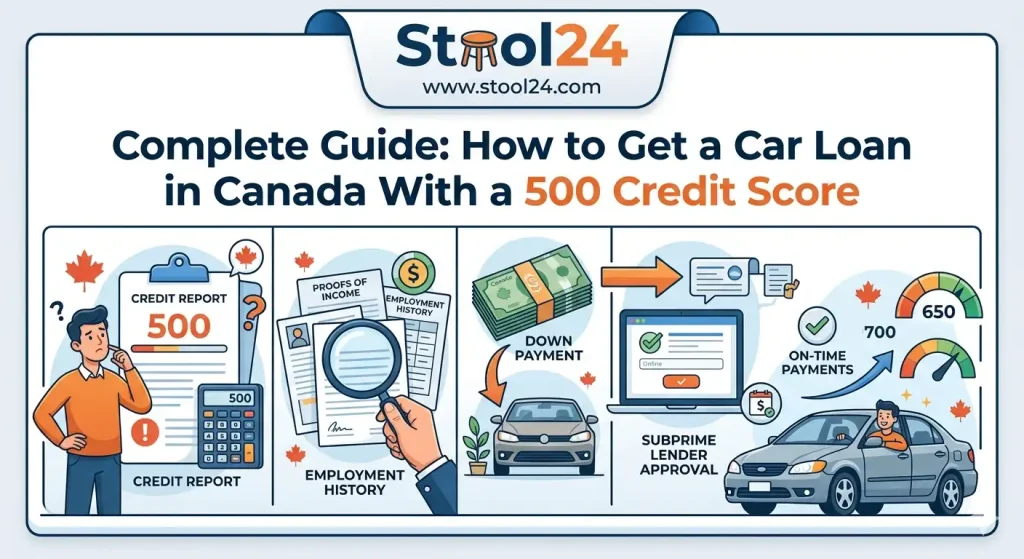
Can You Really Get a Car Loan With a 500 Credit Score in Canada?
Yes, you can get approved—but it won’t look like a typical loan. A 500 score falls into the subprime category in Canada, which means lenders see you as a higher-risk borrower. Still, because auto loans are secured (the car acts as collateral), approval is often possible.
According to Financial Consumer Agency of Canada, lenders in Canada assess more than just your credit score. They also review income, employment stability, and debt levels before making a decision.
Minimum Credit Score Requirements in Canada
Most banks prefer a score above 650. However, alternative lenders and dealerships often accept scores as low as 450–500. The trade-off? Higher interest rates and stricter conditions.
Getting Approved With a 500 Credit Score
If your score is around 500, approval depends on a few key factors:
- Stable monthly income
- Low existing debt
- Down payment (at least 10%)
- Employment history (3–6 months minimum)
To better understand how lenders price risk, check current car loan interest rates in Canada across different credit score ranges.
Prime vs Subprime Borrowers
Prime borrowers get better rates and flexible terms. Subprime borrowers—like someone with a 500 score—face higher APRs and stricter approval rules. Still, many Canadians successfully finance vehicles in this range every year.
How Car Loans Work for Bad Credit Borrowers in Canada
If you’re asking how lenders structure these loans, the answer is simple: they reduce risk on their end. That usually means higher interest and longer repayment terms.
Auto loans in Canada typically range from 36 to 84 months. With bad credit, lenders often push longer terms to reduce monthly payments—but that increases total interest paid.
In provinces like Ontario, Alberta, and British Columbia, lenders must clearly disclose Annual Percentage Rate (APR) and total loan cost under consumer protection laws. This ensures borrowers understand exactly how much they will repay over time.
Interest Rates for 500 Credit Score (CAD Examples)
Interest rates vary widely. With a 500 score, expect anywhere between 10% and 25%, depending on your profile.
You can estimate your exact monthly payment using this auto loan calculator before applying.
Loan Terms Explained
Shorter terms mean higher monthly payments but lower overall cost. Longer terms reduce monthly pressure but increase total repayment. Compare scenarios using a debt-to-income ratio calculator to ensure affordability.
This table shows how loan term length impacts total cost in CAD.
| Loan Term | Monthly Payment | Total Interest Paid |
|---|---|---|
| 36 months | $610 | $1,960 |
| 60 months | $475 | $8,500 |
| 84 months | $395 | $13,000+ |
How Lenders Calculate Risk
Lenders look beyond your score. They evaluate your debt-to-income ratio (DTI), job stability, and repayment history. Learn what’s considered a good debt-to-income ratio before applying. Job stability, and repayment history. According to Equifax Canada, payment history alone makes up about 35% of your credit score—making it the most important factor.
This table shows estimated interest rates and payments based on credit score ranges in Canada.
| Credit Score | Interest Rate | Monthly Payment ($20,000 / 60 months) |
|---|---|---|
| 700+ | 5%–7% | $377–$396 |
| 600–699 | 7%–10% | $396–$425 |
| 500–599 | 10%–20% | $425–$530 |
| Below 500 | 20%–29% | $530–$600+ |
Step-by-Step How to Get a Car Loan in Canada With a 500 Credit Score
If you want approval without unnecessary stress, follow a structured approach. Each step increases your chances significantly.
Step 1 – Check Your Credit Report
Start by reviewing your report from Equifax or TransUnion. Look for errors, unpaid accounts, or outdated information that could hurt your approval.
If your score is low, exploring bad credit loan options in Canada can help you understand alternative approval paths.
Step 2 – Set a Realistic Budget
With a 500 score, With a 500 score, aim for a monthly payment between $300 and $600. Lowering your obligations using strategies to reduce your debt-to-income ratio can improve approval chances.
Step 3 – Save a Down Payment
A 10%–20% down payment shows commitment and lowers lender risk. It also reduces your interest burden.
Step 4 – Choose the Right Lender
Banks are stricter. Subprime lenders and dealership financing are more flexible. Platforms like Canada Drives and Clutch specialize in bad credit approvals, while some borrowers also explore no credit check loan options in Canada for faster approvals.
Step 5 – Apply for Pre-Approval
Pre-approval helps you understand your limits before shopping. It also prevents multiple hard inquiries that can lower your score further.
Need a quick financial planning resource? You can explore tools from tax toolkit to estimate affordability and manage your loan strategy better.
Minimum Requirements to Qualify for a Car Loan in Canada
Lenders don’t approve based on credit score alone. If you’re applying with a 500 score, these are the typical minimum requirements:
- Minimum monthly income: $1,800–$2,500 (see full guide on minimum income required for loan approval)
- Employment stability: at least 3 months
- Valid Canadian driver’s license
- Proof of residence in provinces like Ontario or Alberta
- Down payment (recommended but not always required)
Lenders may also request proof such as pay stubs or bank statements—learn more about documents required for loan approval in Canada.
Meeting these basic criteria significantly increases your chances—even with poor credit.
Best Lenders & Financing Options for Bad Credit in Canada
Different lenders serve different borrower types. Choosing the right one can save you thousands in interest.
Online Platforms
Companies like Canada Drives and Clutch connect borrowers with multiple lenders. They’re fast and often more flexible with credit scores.
Dealership Financing
“Buy here, pay here” dealerships approve more borrowers but usually charge higher rates.
Traditional Banks vs Alternative Lenders
Banks offer lower rates but strict requirements. Alternative lenders are easier to qualify for but cost more.
This table compares lender types based on approval criteria and costs.
| Lender Type | Approval Rate | Interest Rate | Best For |
|---|---|---|---|
| Banks | Low | Low | Good credit borrowers |
| Online Lenders | Medium–High | Medium–High | Bad credit applicants |
| Dealerships | High | High | Quick approvals |
Subprime vs Traditional Car Loans in Canada
This table compares key differences between subprime and traditional auto loans.
| Feature | Subprime Loan | Traditional Loan |
|---|---|---|
| Credit Score | Below 600 | 650+ |
| Interest Rate | High (10%–25%) | Low (5%–8%) |
| Approval Speed | Fast | Moderate |
| Requirements | Flexible | Strict |
Real Example Car Loan Scenario With a 500 Credit Score
Let’s say you’re financing a $20,000 car in Ontario with a 500 credit score.
Example Breakdown
Loan term: 60 months
Interest rate: 15%
Monthly Payment Comparison
At 15%, your monthly payment would be around $475. At 20%, it jumps closer to $530.
Total Cost Over Time
Over five years, you could pay over $8,000 in interest alone. That’s why reducing your rate—even slightly—makes a big difference.
Even a small improvement matters.
Reducing your interest rate by just 3–5% can save thousands over the life of your loan. That’s why preparation before applying is just as important as the application itself.
How to Increase Approval Chances (Expert Strategies)
If approval feels uncertain, these strategies can tilt the odds in your favour.
Add a Co-Signer
A co-signer with good credit can significantly reduce your interest rate and increase approval chances.
Increase Down Payment
Putting more money down lowers the loan amount and risk for lenders.
Reduce Debt-to-Income Ratio
Pay off small debts before applying. Lower DTI improves lender confidence.
Choose a Cheaper Vehicle
Lower loan amounts are easier to approve and come with better terms.
Show Stable Income
Consistent employment for at least 3–6 months strengthens your application.
Expert Insight: Many Canadian borrowers focus only on monthly payments, but lenders structure loans to maximize total interest over time. Choosing a shorter term—even if slightly higher monthly—can save thousands in interest.
Why Car Loan Applications Get Rejected in Canada
Even with flexible lenders, some applications still get denied. Understanding why helps you avoid common pitfalls.
- High debt-to-income ratio (above 45%)
- Unstable job history
- No down payment at all
- Too many recent credit inquiries
- Previous loan defaults or repossessions
Fixing even one of these issues can significantly improve approval chances.
They also verify employment and income carefully—here’s how lenders verify income in Canada before approving loans.
Ready to Apply for a Car Loan?
If your credit score is around 500, preparation is everything. Start by checking your credit report, setting a realistic budget in CAD, and comparing lenders carefully. Even small improvements—like a higher down payment or lower debt—can reduce your interest rate significantly.
Take action now, but make sure you apply strategically to avoid unnecessary credit checks.
Common Mistakes to Avoid With Bad Credit Car Loans
Small mistakes can cost you big. Avoid these common pitfalls:
- Applying to too many lenders at once
- Ignoring total loan cost
- Accepting extremely high interest rates without comparison
- Skipping pre-approval
- Not reading contract terms carefully
Pros: Easier approval, chance to rebuild credit, access to transportation
Cons: Higher interest rates, stricter terms, higher total cost
Can a Car Loan Help Improve Your Credit Score in Canada?
Yes, if managed properly, a car loan can rebuild your credit over time. Payment history is the biggest factor in your credit score.
How Payment History Affects Your Score
On-time payments show lenders you’re reliable. Even 6–12 months of consistent payments can improve your score.
Timeline for Improvement
Many borrowers move from 500 to 650 within 12–24 months with disciplined repayment.
Best Practices for Credit Rebuilding
- Always pay on time
- Keep other debts low
- Avoid missed or late payments
Quick Summary
Getting a car loan in Canada with a 500 credit score is possible, but it requires planning. Expect higher interest rates, but you can reduce costs by increasing your down payment, choosing the right lender, and improving your financial profile. Focus on affordability, avoid common mistakes, and use the loan as a tool to rebuild your credit over time.
Author Note: This guide is based on Canadian lending practices, credit bureau data, and real borrower scenarios to provide practical, accurate financial guidance.
FAQS For How to Get a Car Loan in Canada With a 500 Credit Score
Can I really get approved for a car loan with a 500 credit score in Canada?
Yes, approval is possible through subprime lenders or dealership financing. However, expect higher interest rates (often 10%–25% APR) and stricter requirements like stable income and a down payment. Approval depends more on your financial profile than just your credit score.
What interest rate will I pay with a 500 credit score in Canada?
Most borrowers with a 500 score pay between 10% and 20% interest, depending on income and debt levels. For example, a $20,000 loan over 60 months could cost around $450–$530 per month. Rates may vary slightly across provinces like Ontario or Alberta.You can calculate exact costs using our car loan calculator.
How much down payment is required for bad credit car loans?
In Canada, lenders typically expect at least 10%–20% down for bad credit borrowers. On a $15,000 vehicle, that means $1,500 to $3,000 upfront. A higher down payment can reduce your interest rate and improve approval chances.
Which lenders accept a 500 credit score in Canada?
Alternative lenders, online platforms, and “buy here, pay here” dealerships are more flexible with low credit scores. Traditional banks usually require 600+ scores, but some may consider applications with a co-signer. Always compare options before committing.
What income do I need to qualify for a car loan in Canada?
There’s no fixed minimum, but most lenders look for steady income that covers your monthly expenses and loan payment. A common guideline is keeping your debt-to-income ratio below 40%. Proof of employment for at least 3–6 months is often required.
Can a car loan help improve my credit score in Canada?
Yes, making on-time payments can gradually improve your score. According to Canadian credit bureaus, payment history is the most important factor in your credit profile. Many borrowers see improvement within 12–24 months of consistent payments.
Is it possible to refinance a bad credit car loan later?
Yes, refinancing is possible once your credit score improves, usually after 6–12 months of on-time payments. This can lower your interest rate and monthly payment. Check lender policies and ensure there are no penalties before refinancing.