
A couple earning $90,000 a year in Canada faces a familiar dilemma: rent a downtown apartment for $2,200/month or buy a condo with a $450,000 mortgage. The monthly costs look similar, but the long-term impact? That’s where things get complicated. If you’re wondering is it better to rent or buy in Canada, the answer depends on more than just today’s payment. It comes down to time, flexibility, hidden costs, and future value. In this guide, you’ll see a clear cost comparison, real-life scenarios, and a practical framework to help you decide with confidence.
Table of Contents
Is It Better to Rent or Buy in Canada? A Complete Cost & Lifestyle Comparison
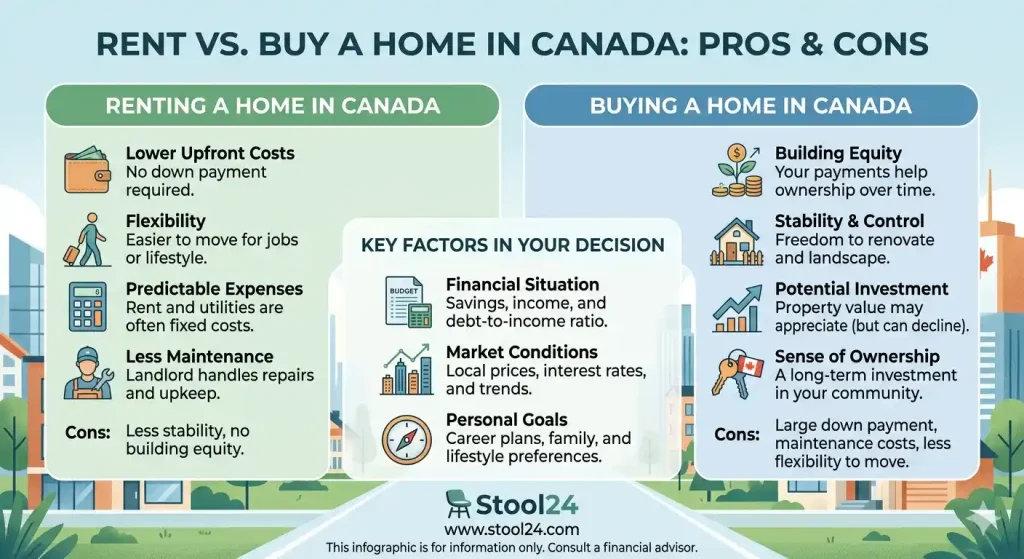
Renting vs Buying in Canada — What’s the Real Difference?
At its core, renting means paying for flexibility, while buying means investing in ownership. One gives you freedom to move, the other builds long-term equity.
When you rent in Canada, your monthly payment goes to a landlord. You avoid property taxes, maintenance costs, and large upfront expenses. It’s simple, predictable, and ideal for short-term living.
Buying, on the other hand, involves a mortgage, closing costs, and ongoing expenses. But each payment builds equity, which can grow over time if property values increase.
That’s the trade-off: flexibility versus long-term financial gain.
Is It Better to Rent or Buy in Canada Right Now? (2026 Market Reality)
To answer whether is it better to rent or buy in Canada today, you need to look at current market conditions.
According to Bank of Canada, mortgage rates have remained higher compared to pre-2020 levels. This directly increases borrowing costs and monthly payments.
At the same time, rental prices have surged in major cities. Data from Statistics Canada shows rent has increased steadily, especially in urban areas.
In simple terms, both renting and buying are expensive right now — just in different ways.
Short answer: there’s no universal winner.
The better option depends on your timeline, income stability, and how long you plan to stay in one place. A buyer staying 10+ years may benefit, while a renter staying 2–3 years likely avoids unnecessary costs.
Full Cost Breakdown — Renting vs Buying
This table compares the true costs of renting vs buying in Canada.
| Renting vs Buying Cost Comparison in Canada | Renting | Buying |
|---|---|---|
| Monthly Payment | Fixed rent | Mortgage + interest |
| Upfront Cost | Low (deposit) | High (down payment + closing) |
| Maintenance | Landlord pays | Owner pays |
| Property Taxes | None | Required |
| Equity | None | Builds over time |
| Flexibility | High | Low |
Many people underestimate the hidden costs of ownership. Maintenance alone can reach 1%–3% of a home’s value annually.
Also consider opportunity cost — money tied up in a down payment could be invested elsewhere.
The Break-Even Point — When Buying Becomes Worth It
One of the most important questions is: how long do you need to stay for buying to make sense?
In Canada, the typical break-even point ranges between 5 to 7 years. This depends on closing costs, interest rates, and market growth.
The “5% rule” is often used as a quick guideline. It suggests that if the annual cost of owning exceeds 5% of the property value, renting may be better.
For example:
- $500,000 home → 5% = $25,000/year cost
- If ownership costs exceed this, renting could be more efficient
This is where using tools becomes useful.
To get a personalized answer based on your numbers, try a quick calculation below.
Use a simple tool to estimate your monthly costs and long-term savings.
[ Calculate Rent vs Buy Now ]
https://www.stool24.com/rent-vs-buy-calculator-canada/
Real-Life Scenarios — Who Should Rent vs Who Should Buy?
Different situations lead to different answers. There’s no one-size-fits-all decision.
First-Time Buyer with Limited Savings
If you have minimal savings, renting may be the safer option. Buying requires upfront cash, and unexpected costs can quickly add up.
High-Income Professional Planning Long-Term Stay
Buying makes more sense if you plan to stay in one place for 7+ years. You benefit from equity growth and potential appreciation.
Short-Term Residents or Frequent Movers
If you move often, renting avoids transaction costs like realtor fees and land transfer taxes.
Families vs Single Individuals
Families often prefer stability, making buying attractive. Singles may value flexibility more.
The right choice depends on your life stage.
And your future plans matter more than today’s numbers.
Pros and Cons of Renting vs Buying in Canada
Understanding the advantages and disadvantages helps clarify your decision.
Pros of Renting
- Lower upfront costs
- Flexibility to move anytime
- No maintenance responsibility
Cons of Renting
- No equity building
- Rent increases over time
- Less control over living space
Pros of Buying
- Builds equity over time
- Stable housing costs (fixed mortgage)
- Potential property appreciation
Cons of Buying
- High upfront costs
- Maintenance expenses
- Market risk
Step-by-Step Decision Guide — Should You Rent or Buy?
Still unsure? Follow this simple framework to decide.
- Check your finances: Can you afford a down payment and emergency fund?
- Compare monthly costs: Include taxes, insurance, and maintenance.
- Think long-term: Will you stay at least 5 years?
- Analyze the market: Interest rates and home prices matter.
- Use tools: Try calculators and planning resources like the tax toolkit to estimate financial impact.
Taking these steps removes guesswork and gives you clarity.
Common Mistakes Canadians Make When Choosing
Even smart buyers and renters make avoidable mistakes.
- Ignoring hidden ownership costs
- Assuming prices always go up
- Buying without long-term plans
- Believing rent is always “wasted money”
According to Canada Mortgage and Housing Corporation (CMHC), many first-time buyers underestimate total ownership costs, leading to financial stress.
A better approach is to look at total cost, not just monthly payments.
Expert Tips to Make the Right Decision in Canada
Experts suggest focusing on long-term financial health rather than short-term savings.
If interest rates are high, renting and investing the difference can sometimes outperform buying. On the flip side, stable markets with long-term ownership favour buying.
Programs like the Home Buyers’ Plan (HBP) and First-Time Home Buyer Incentive can reduce upfront costs, but they don’t eliminate risk.
The key is balance — financial readiness plus lifestyle alignment.
FAQS For is it better to rent or buy in Canada
Is it cheaper to rent or buy in Canada in 2026?
It depends on location and interest rates. In many Canadian cities, renting is cheaper short term, while buying can be more cost-effective over 5–10 years if property values rise. Always compare total ownership costs, not just mortgage payments.
How long should I stay in a home for buying to be worth it in Canada?
Most experts suggest staying at least 5 to 7 years. This allows you to recover closing costs and benefit from equity growth. Shorter stays often make renting the better financial choice.
Is renting a waste of money in Canada?
No, renting is not wasted money—it pays for flexibility and lower financial risk. In some cases, renters can invest savings and build wealth faster than homeowners. It depends on your financial strategy and goals.
What income do I need to buy a house in Canada?
The required income varies by city and home price. Generally, lenders recommend keeping housing costs below 39% of your gross income. You can use tools like a rent vs buy calculator to estimate affordability based on your situation.
What are the hidden costs of owning a home in Canada?
Beyond the mortgage, homeowners pay property taxes, maintenance, insurance, and utilities. These can add thousands per year and are often underestimated. Budgeting for these costs is essential before buying.
Should I buy a home in Canada when interest rates are high?
High interest rates increase borrowing costs, making buying less attractive in the short term. However, if you plan to stay long-term, you may still benefit from future refinancing and property appreciation. Timing the market perfectly is difficult.
What is the 5% rule in renting vs buying?
The 5% rule estimates the annual cost of owning a home as 5% of its value. If your total ownership costs exceed this, renting may be the better option. It’s a quick guideline, not a strict rule.
Quick Summary
So, is it better to rent or buy in Canada? It depends on your timeline, finances, and goals.
- Renting offers flexibility and lower upfront costs
- Buying builds equity but requires long-term commitment
- Break-even typically takes 5–7 years
- Market conditions and interest rates play a major role
If you’re staying long-term and financially stable, buying may be worth it. If flexibility matters or your future is uncertain, renting could be the smarter move.