
A customer in Toronto buys a $100 item and pays $113 at checkout. Someone in Calgary buys the same product and pays only $105. That difference often surprises shoppers and business owners alike. Understanding sales tax rates by province Canada is essential when budgeting purchases, setting prices, or running an online store.
Canada’s sales tax system combines federal and provincial taxes, which means rates vary depending on where you live or sell products. This guide explains how GST, PST, HST, and Quebec’s QST work, shows the current tax rates across provinces and territories, and walks through real examples so you can calculate taxes accurately and avoid common mistakes.
Table of Contents
Sales Tax Rates by Province Canada (GST, PST & HST Guide)
Canada’s consumption tax system may look complicated at first glance, but it follows a clear structure. The federal government applies a nationwide Goods and Services Tax (GST), while provinces may add their own tax or combine it with the federal system. Because of this structure, total tax rates differ across provinces.
Knowing the exact rates helps consumers estimate real costs and helps businesses charge the correct tax at checkout. The following sections break down how the system works and where each province fits.
Understanding How Sales Tax Works in Canada
Canada uses a layered tax system where federal and provincial governments share responsibility for consumption taxes. The result is three main tax types used across the country: GST, PST, and HST.
The federal government sets the nationwide GST rate at 5%. Provinces then decide whether to add their own tax or combine it with the federal tax.
Goods and Services Tax (GST)
The Goods and Services Tax is a federal consumption tax applied across Canada. Introduced in 1991, the rate remains 5% today. According to the Canada Revenue Agency, GST applies to most goods and services unless specifically exempt.
Even provinces with their own tax still include the 5% federal portion.
Provincial Sales Tax (PST)
Some provinces charge their own Provincial Sales Tax on top of GST. In these provinces, businesses must calculate two separate taxes.
- British Columbia
- Saskatchewan
- Manitoba
- Quebec (uses QST instead of PST)
This system requires slightly more bookkeeping for businesses, but it allows provinces to control their own tax policy.
Harmonized Sales Tax (HST)
Several provinces combine their provincial tax with the federal GST into a single Harmonized Sales Tax. Instead of calculating two taxes, businesses charge one combined rate.
The federal government administers HST through the Canada Revenue Agency, which simplifies tax collection for many companies.
Want a deeper explanation of the differences between these systems? This guide explains it clearly in the GST vs HST difference article.
Sales Tax Rates by Province Canada
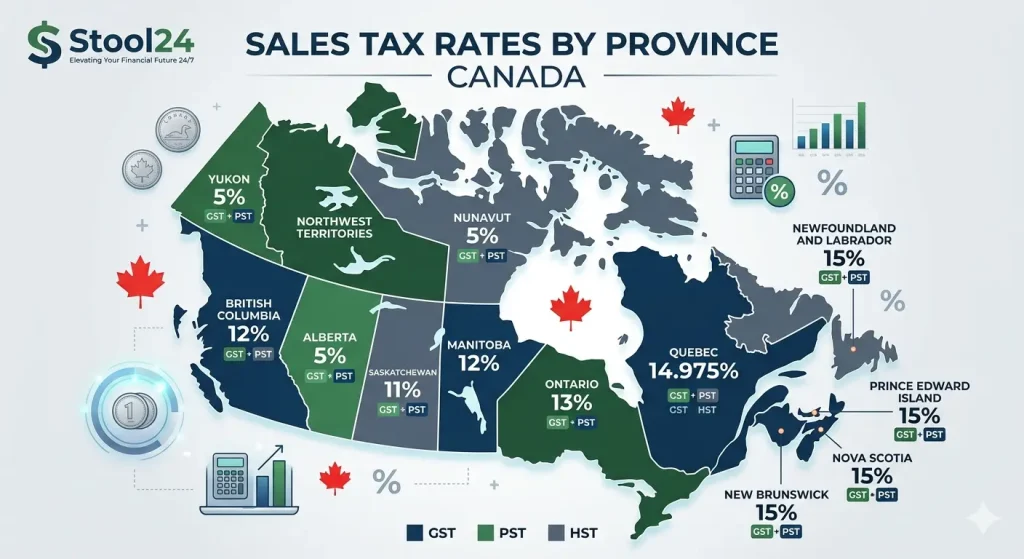
The table below shows the latest sales tax rates by province Canada, including federal and provincial portions.
Canada sales tax chart by province and territory
| Province / Territory | Tax Type | GST | Provincial Portion | Total Tax Rate |
|---|---|---|---|---|
| Alberta | GST | 5% | 0% | 5% |
| British Columbia | GST + PST | 5% | 7% | 12% |
| Saskatchewan | GST + PST | 5% | 6% | 11% |
| Manitoba | GST + PST | 5% | 7% | 12% |
| Ontario | HST | — | — | 13% |
| Quebec | GST + QST | 5% | 9.975% | 14.975% |
| New Brunswick | HST | — | — | 15% |
| Nova Scotia | HST | — | — | 14% |
| Newfoundland & Labrador | HST | — | — | 15% |
| Prince Edward Island | HST | — | — | 15% |
| Northwest Territories | GST | 5% | 0% | 5% |
| Yukon | GST | 5% | 0% | 5% |
| Nunavut | GST | 5% | 0% | 5% |
These rates are consistent with tax information published by the Department of Finance Canada.
Provinces With Only GST (No Provincial Tax)
Some Canadian regions apply only the federal GST. That means consumers pay the lowest possible sales tax rate in the country.
These include:
- Alberta
- Yukon
- Northwest Territories
- Nunavut
This makes Alberta particularly attractive for large purchases like electronics, vehicles, or appliances.
One simple rule helps shoppers remember the cheapest region.
If there is no provincial tax, you only pay 5%.
That single fact explains why Alberta often ranks as the province with the lowest consumption tax burden for everyday goods.
Provinces Using Harmonized Sales Tax (HST)
Several provinces chose to harmonize their provincial tax with the federal GST. The goal was to simplify tax administration and reduce compliance costs for businesses.
Instead of two separate taxes, retailers charge one combined rate.
HST Rates by Province
The following table shows provinces using the HST system.
Harmonized Sales Tax rates across Canada
| Province | HST Rate |
|---|---|
| Ontario | 13% |
| Nova Scotia | 14% |
| New Brunswick | 15% |
| Newfoundland & Labrador | 15% |
| Prince Edward Island | 15% |
The Statistics Canada consumer tax reports show Atlantic provinces consistently rank among the highest combined tax regions in the country.
Example: Calculating Sales Tax in Different Provinces
Understanding tax rates becomes easier when you see how they affect real purchases. The example below compares a $100 item purchased in different provinces.
Final price comparison after provincial sales taxes
| Province | Item Price | Tax Rate | Total Price |
|---|---|---|---|
| Alberta | $100 | 5% | $105 |
| Ontario | $100 | 13% | $113 |
| British Columbia | $100 | 12% | $112 |
| Quebec | $100 | 14.975% | $114.98 |
These examples show how small percentage differences can significantly affect final purchase prices.
For quick calculations while shopping or running a business, a simple calculator can make things easier.
Highest and Lowest Sales Taxes in Canada
Which provinces charge the most tax? The answer depends on combined provincial and federal rates.
- Highest: Quebec (14.975%) and several Atlantic provinces (15%)
- Lowest: Alberta and northern territories (5%)
Pros and Cons of Higher Provincial Taxes
- Pros
- Supports provincial programs and infrastructure
- Helps fund healthcare and education
- Cons
- Higher consumer prices
- Potential impact on cross-province shopping
Important Rules for Businesses Charging Sales Tax
Businesses operating in Canada must follow federal and provincial rules when collecting sales tax. Registration requirements usually begin once annual taxable revenue reaches $30,000.
The Canada Revenue Agency GST/HST guidelines outline when companies must register and collect tax.
Key Rules Businesses Should Know
- Charge tax based on the customer’s province
- Register for GST/HST if revenue exceeds $30,000
- Separate PST registration may be required
- Online sellers must apply destination-based tax rules
These rules matter especially for e-commerce stores selling across provinces.
Many businesses simplify the process using tools from the tax toolkit, which includes practical resources for Canadian tax calculations and compliance.
Common Sales Tax Mistakes in Canada
Even experienced entrepreneurs sometimes make mistakes with Canadian sales taxes. The system involves multiple jurisdictions and rules.
- Charging the wrong provincial rate
- Forgetting PST registration
- Confusing GST with HST
- Misunderstanding tax-exempt products
Careful record-keeping and accurate calculation tools help reduce these risks.
FAQS For Sales Tax Rates by Province Canada
What is the sales tax in each province in Canada?
Sales tax in Canada varies by province because it combines federal GST with provincial taxes. The federal GST is 5%, while provinces may add PST or use HST. For example, Ontario charges 13% HST, while Alberta only applies the 5% GST.
Which province has the lowest sales tax in Canada?
Alberta has the lowest sales tax rate in Canada because it does not charge provincial sales tax. Consumers only pay the 5% federal GST. The territories—Yukon, Northwest Territories, and Nunavut—also follow this same 5% rate.
Which province has the highest sales tax in Canada?
Several Atlantic provinces have the highest sales tax rate at 15% HST. These include New Brunswick, Newfoundland and Labrador, and Prince Edward Island. Quebec is also among the highest at a combined rate of 14.975%.
What is the difference between GST, PST, and HST in Canada?
GST is the federal Goods and Services Tax applied across Canada at 5%. PST is a provincial tax added separately in some provinces like British Columbia or Saskatchewan. HST combines federal and provincial taxes into one single rate, making tax collection simpler for businesses.
Do all Canadian provinces charge provincial sales tax?
No, not all provinces charge provincial sales tax. Alberta and the three northern territories only apply the federal GST. Other provinces either charge PST separately or combine it with GST through the HST system.
How do businesses know which sales tax rate to charge?
Businesses must charge tax based on the customer’s location, not the business location. This is called the destination-based rule used in Canada’s tax system. Online sellers and e-commerce stores especially need to apply the correct provincial rate.
How can I quickly calculate GST or HST in Canada?
You can estimate sales tax by multiplying the purchase price by the provincial tax rate. For example, a $100 purchase in Ontario adds 13% HST, making the final price $113. Many Canadians use online GST/HST calculators to quickly determine the exact tax amount.
Quick Summary
Canada’s sales tax system combines federal and provincial taxes, which explains why rates vary across the country. The federal GST is 5%, while provinces either add their own PST or combine it into HST.
- Lowest sales tax: Alberta and northern territories (5%)
- Highest sales tax: Atlantic provinces and Quebec
- HST provinces charge one combined tax
- PST provinces require separate tax calculations
Understanding sales tax rates by province Canada helps shoppers estimate costs and allows businesses to charge the correct tax every time.