
A parent in Canada might welcome a newborn and assume financial support starts automatically. In reality, knowing how to apply for child tax benefit can make the difference between receiving payments quickly or waiting months. The process isn’t complicated, but small mistakes—like missing documents or delayed tax filing—can slow everything down.
This guide walks you through exactly how to apply, what documents you need, and how to avoid delays. You’ll also learn how payments are calculated, when they start, and how to maximize your benefit with practical tips.
According to the Canada Revenue Agency (CRA), millions of Canadian families receive the Canada Child Benefit each year. Applying correctly the first time helps avoid delays and ensures you receive payments as early as possible.
Table of Contents
How to Apply for Child Tax Benefit in Canada (Step-by-Step Guide for 2026)
The Canada Child Benefit (CCB) is a tax-free monthly payment designed to help families with the cost of raising children under 18. It’s administered by the Canada Revenue Agency (CRA) and is based on your household income.
Why Applying Early for Child Tax Benefit Matters
Applying as soon as possible ensures you don’t miss out on monthly tax-free payments. Even a delay of a few months can mean losing hundreds or thousands in benefits, especially for low-income families.
- Faster access to monthly payments
- Avoid retroactive paperwork delays
- Better financial planning for childcare costs
Early applications also reduce the risk of document verification issues later in the process.
What Is the Canada Child Benefit (CCB) and Who Qualifies?
If you’re wondering whether you’re eligible, the rules are fairly straightforward. You must live with the child, be primarily responsible for their care, and be a resident of Canada for tax purposes.
What is the Canada Child Benefit and how it works
The CCB provides monthly payments that vary based on your income and number of children. According to the Canada Revenue Agency, families can receive up to several thousand dollars per year per child, depending on income levels.
Eligibility requirements you must meet
To qualify, you must:
- Be a Canadian resident for tax purposes
- Live with the child and be the primary caregiver
- File your annual tax return
Even if you had no income, filing taxes is mandatory to receive payments.
Who cannot apply (common exclusions)
Some situations disqualify applicants. For example, if you are not primarily responsible for the child or haven’t filed taxes, your application may be denied or delayed.
How to Apply for Child Tax Benefit in Canada (3 Easy Methods)
Understanding how to apply for child tax benefit comes down to choosing the right method. Each option works, but one is clearly faster.
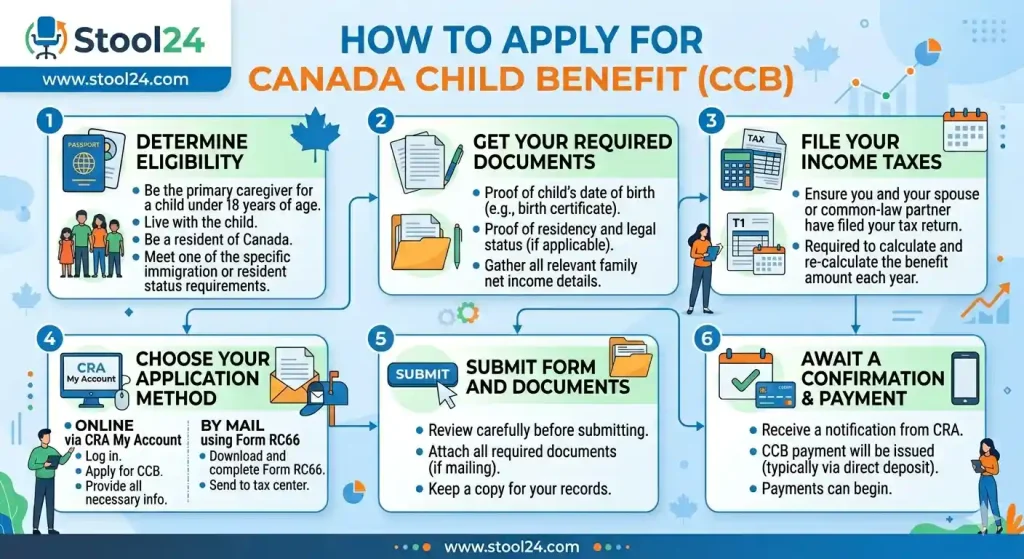
Apply online through CRA My Account (fastest method)
The quickest way is through CRA My Account. Once logged in, you can submit your application in minutes.
- Log in to CRA My Account
- Select “Apply for child benefits”
- Enter your child’s details
- Upload required documents
- Submit your application
This method typically processes faster than paper applications.
Apply using Form RC66 by mail
If you prefer paper, you can complete Form RC66 and mail it to the CRA. This method is useful if you don’t have online access.
However, processing times are longer, often taking several weeks.
Apply when registering your child’s birth
Many provinces allow you to apply during birth registration. This is the easiest option for new parents because it combines multiple steps into one.
It reduces paperwork and speeds up approval.
This table compares the different ways to apply for child tax benefit in Canada.
| Application Method | Processing Speed | Best For |
|---|---|---|
| Online (CRA My Account) | Fast (2–8 weeks) | Most applicants |
| Mail (Form RC66) | Slow (6–12 weeks) | No online access |
| Birth Registration | Fastest | New parents |
Documents Required to Apply for Child Tax Benefit
Before applying, gather your documents. Missing paperwork is one of the biggest causes of delays.
Identity and residency documents
You’ll need:
- Social Insurance Number (SIN)
- Proof of residency
- Immigration documents (if applicable)
Child-related documents
To prove eligibility, provide:
- Birth certificate
- Proof the child lives with you
Additional documents for special cases
Some situations require extra proof. Shared custody cases may need agreements, while newcomers might need immigration records.
It’s better to submit more information upfront than face delays later.
In some cases, the CRA may request additional verification documents. According to official CRA guidelines, incomplete applications are one of the most common reasons for delayed approvals.
Processing Time, Payment Dates, and How Much You’ll Get
After applying, the next question is usually about timing and payment amounts.
How long it takes to receive CCB after applying
Online applications are often processed within 8 weeks, while mailed applications may take longer. Delays happen if documents are missing.
Once approved, payments begin shortly after processing is complete.
CCB payment dates and schedule
The CRA issues payments monthly, typically around the 20th. You can check exact dates on the official schedule.
How benefit amounts are calculated
CCB payments depend on your adjusted family net income.
This table shows estimated monthly benefits based on income levels.
| Family Income | Estimated Monthly Benefit |
|---|---|
| Under $35,000 | Higher maximum payment |
| $35,000 – $75,000 | Moderate payment |
| Above $75,000 | Reduced payment |
For precise estimates, using a calculator makes things easier.
Want a quick estimate of your monthly benefit? Try a simple tool to calculate your payments based on income and number of children.
What Happens After You Apply? (Tracking, Updates & Retroactive Payments)
Submitting your application isn’t the final step. You still need to monitor and manage your account.
How to check your application status
You can track your status through CRA My Account. Updates usually appear within a few weeks.
When and how payments start
Payments typically begin once your application is approved. Direct deposit is faster than receiving cheques by mail.
Can you get retroactive CCB payments?
Yes, you can claim retroactive payments for up to 10 years if you were eligible but didn’t apply.
However, you must file all required tax returns to qualify.
Common Mistakes to Avoid When Applying for Child Tax Benefit
Many delays come from simple, avoidable errors.
- Not filing taxes – even with zero income
- Incomplete documents – missing proof slows approval
- Wrong application method – using mail instead of online
Pros and Cons of Application Methods
| Method | Pros | Cons |
|---|---|---|
| Online | Fast, convenient | Requires CRA account |
| No online access needed | Slow processing | |
| Birth Registration | Automatic, easy | Only available at birth |
Understanding your full financial picture can also reduce mistakes. You can explore tools like a debt-to-income ratio calculator to better plan eligibility and financial stability.
Pros and Cons of Applying for Child Tax Benefit
Understanding both advantages and limitations helps you make better financial decisions.
Pros:
- Tax-free monthly income
- Supports childcare and living costs
- Automatically adjusted based on income
Cons:
- Requires annual tax filing
- Delays if documents are incomplete
- Payments reduce as income increases
Expert Tips to Get Approved Faster and Maximize Your Benefits
Small actions can make a big difference in how quickly you receive payments.
File taxes on time every year
The CRA uses your tax return to calculate benefits. Late filing can stop payments completely.
Set up direct deposit with CRA
This ensures faster payments and reduces the risk of lost cheques.
Keep your family information updated
Changes like marital status or address should be updated immediately to avoid payment issues.
For managing multiple tax-related tools and benefits, many families use a centralized resource like tax toolkit to stay organized.
Real-Life Examples (New Parents, Immigrants, Shared Custody)
Understanding how to apply for child tax benefit becomes clearer with real scenarios.
Example 1: First-time parent applying after birth
A new parent registers their child at birth and applies immediately. Payments begin within two months, avoiding delays.
Example 2: New immigrant applying late
A family moving to Canada applies six months later. They still receive retroactive payments after filing taxes and submitting documents.
Example 3: Divorced parents with shared custody
In shared custody, both parents may receive partial payments, depending on the arrangement.
According to Government of Canada benefits, eligibility depends on who is primarily responsible for the child.
Get an Instant Estimate of Your Child Benefit
Not sure how much you’ll receive? A quick estimate can help you plan your monthly budget more effectively.
[Check Your CCB Eligibility & Payment]
FAQS For how to apply for child tax benefit
How do I apply for child tax benefit in Canada?
You can apply online through your CRA My Account, by mail using Form RC66, or during your child’s birth registration. The online method is the fastest and most convenient. Make sure all required documents are submitted to avoid delays.
How long does it take to receive CCB after applying?
Most applications are processed within 8 weeks if submitted online. Paper applications may take longer, especially if documents are missing. Payments usually begin shortly after approval.
Can I apply for child tax benefit if I am a new immigrant?
Yes, new immigrants can apply once they become residents for tax purposes. You’ll need to provide immigration documents and file your tax return. In some cases, you may also qualify for retroactive payments.
Is the child tax benefit automatic after birth?
It can be automatic if you apply during your child’s birth registration in participating provinces. Otherwise, you must apply manually through CRA. Missing this step can delay your payments.
What documents are required to apply for child tax benefit?
You’ll need your SIN, your child’s birth certificate, and proof of residency. Additional documents may be required for shared custody or immigration status. Submitting complete documents helps speed up approval.
Can both parents apply for the Canada Child Benefit?
Typically, only the primary caregiver receives the benefit. In shared custody cases, payments may be split between both parents. The CRA determines eligibility based on caregiving responsibilities.
Can I claim child tax benefit for previous years?
Yes, you can request retroactive payments for up to 10 years. However, you must file all required tax returns for those years. The CRA will calculate the amount based on your past income.
Expert Insight: What Most Applicants Overlook
One of the most overlooked steps is keeping your tax filings updated every year. Even if your situation hasn’t changed, missing a tax return can stop your payments completely.
Based on CRA data, payment interruptions are often linked to outdated personal information or unfiled returns rather than eligibility issues.
Quick Summary
Applying for the Canada Child Benefit is straightforward when you understand the steps. The fastest method is online through CRA My Account, and having complete documents speeds up approval. Payments depend on your income and are issued monthly. Avoid common mistakes like not filing taxes, and always keep your information updated.