
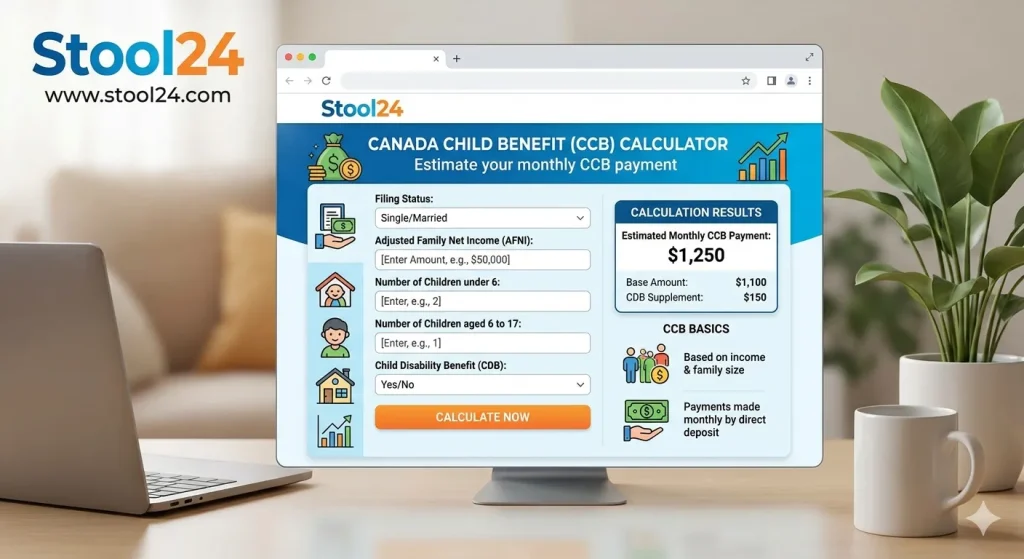
Enter your details in the boxes, then click the Calculate button to see your full CCB result.
CCB Calculator Canada
A family earning $45,000 with two young children can receive thousands of dollars per year through the Canada Child Benefit. But how do you know your exact amount without guessing? That’s where a CCB calculator Canada becomes essential. It gives you a quick estimate based on income, number of children, and province. In this guide, you’ll not only calculate your benefit but also understand how it’s determined, how to increase it legally, and what most calculators fail to explain.
You’ll learn the real formula behind payments, income thresholds, provincial bonuses, and practical strategies to maximize your monthly support.
Table of Contents
CCB Calculator Canada Estimate Your Canada Child Benefit (2026 Guide)
The Canada Child Benefit is a tax-free monthly payment designed to support families raising children. It’s administered by the Canada Revenue Agency, and the amount varies based on income and family size. Using a reliable calculator helps you avoid confusion and get an accurate estimate within seconds.
Who should use this calculator? This tool is designed for Canadian parents, new immigrants, single-income households, and dual-income families who want to estimate their monthly child benefit based on real Canada Revenue Agency (CRA) rules.
Whether you’re living in Ontario, British Columbia, Alberta, or Quebec, this calculator adjusts your estimate based on income thresholds, provincial benefits, and family size—giving you a realistic projection in CAD ($).
Why Trust This CCB Calculator?
- Based on official Canada Revenue Agency (CRA) formulas
- Uses updated 2026 benefit thresholds and reduction rates
- Includes Child Disability Benefit (CDB) estimates
- Accounts for provincial bonus payments (Ontario, BC, etc.)
- Designed for real-life financial planning—not rough guesses
This calculator is built using publicly available CRA guidelines and simplified into an easy-to-use format for everyday families.
What Is the Canada Child Benefit (CCB)?
The Canada Child Benefit (CCB) is a federal program that provides financial support to eligible families. It is completely tax-free and recalculated every year based on your income.
Eligibility depends on residency, income, and whether you are the primary caregiver of a child under 18. The benefit aims to reduce child poverty—according to Government of Canada data, it has helped lift hundreds of thousands of children above the poverty line.
Key Eligibility Requirements
To qualify for the CCB, you must meet a few basic criteria:
- Be a resident of Canada for tax purposes
- Live with a child under 18
- Be primarily responsible for the child’s care
- File your annual tax return
If you miss filing taxes, your payments may stop—even if you qualify.
Maximum CCB Amount Per Child
The benefit amount depends on the child’s age. Younger children receive higher support.
Table: Maximum Annual CCB Payment Per Child
| Child Age | Maximum Annual Amount |
|---|---|
| Under 6 | $7,437 |
| Age 6–17 | $6,275 |
These are maximum amounts. Your actual benefit depends on your household income.
How the CCB Calculator Canada Works
A CCB calculator Canada estimates your benefit by combining your income, number of children, and province. It simplifies a complex formula used by the Canada Revenue Agency.
If you want to understand your full financial picture, you can also explore our Tax Toolkit for additional tools and insights.
Inputs Required for Accurate Results
To get a reliable estimate, you need:
- Adjusted family net income (AFNI)
- Number of children
- Ages of children
- Province of residence
Even small changes in income can significantly affect your result.
What Is Adjusted Family Net Income (AFNI)?
AFNI is your total family income after certain deductions. It’s the key number used to calculate your benefit.
For example, if your combined household income is $60,000, your CCB will be reduced compared to someone earning $30,000. The higher your income, the lower your benefit.
CCB Formula Explained (Simplified)
The official formula is complex, but here’s a simplified version:
- Start with the maximum benefit per child
- Apply income thresholds
- Reduce benefit using clawback rates
- Add any provincial or disability benefits
According to Canada Revenue Agency, the reduction begins once income exceeds around $34,000.
One key thing to remember.
Your benefit does not drop suddenly—it decreases gradually as income rises, which makes planning easier if your earnings change year to year.
Official Calculation Insight: The Canada Child Benefit is calculated using a tiered reduction system. The CRA applies two income thresholds:
- First threshold: ~$34,863 CAD
- Second threshold: ~$75,537 CAD
Reduction rates increase as income crosses these thresholds, which means higher-income households experience faster benefit reduction.
CCB Calculator Canada — Example Scenarios
Seeing real examples makes the calculation clearer. Here are three typical cases.
Example 1: Low-Income Family
A family earning $30,000 with two children under 6 may receive close to the maximum—around $14,000 annually.
Example 2: Middle-Income Family
At $70,000 income, the same family might receive about $8,000–$10,000 annually depending on province.
Example 3: High-Income Reduction
At $120,000 income, benefits drop significantly, possibly below $3,000 per year.
Table: Example Monthly Breakdown
| Income | Annual CCB | Monthly Payment |
|---|---|---|
| $30,000 | $14,000 | $1,166 |
| $70,000 | $9,000 | $750 |
| $120,000 | $2,800 | $233 |
These are estimates, but they show how strongly income impacts your benefit.
CCB Calculator vs CRA Official Calculation
| Feature | This Calculator | CRA Official Assessment |
|---|---|---|
| Speed | Instant | Weeks after tax filing |
| Accuracy | Estimated | Exact |
| Includes Provincial Benefits | Yes (basic) | Yes (full) |
| Ease of Use | Very easy | Complex |
Bottom line: This calculator gives you a fast estimate, but your final amount is confirmed by the CRA after your tax return is processed.
CCB Payment Amounts & Income Thresholds
Understanding thresholds helps you predict how changes in income affect your benefit.
Maximum Benefit Table (Updated)
The table below shows how income levels impact benefits.
Table: Income vs Benefit Reduction
| Income Range | Impact on CCB |
|---|---|
| Below $34,000 | Maximum benefit |
| $34,000–$75,000 | Gradual reduction |
| Above $75,000 | Higher reduction rate |
Income Thresholds & Clawback Rates
The government applies different reduction rates depending on income and number of children. Families with more children may see slower reductions.
How Benefits Decrease with Income
As income rises, benefits decrease in stages—not all at once. This helps families adjust gradually without sudden financial loss.
Provincial Child Benefits (Bonus Payments)
In addition to federal payments, provinces offer extra support. These can add hundreds or even thousands per year.
Ontario Child Benefit
Provides additional monthly support based on income.
Alberta Child and Family Benefit
Combines base and working income components.
BC Family Benefit
Offers enhanced payments for lower-income families.
Each province in Canada has its own child benefit programs. For example:
- Ontario: Ontario Child Benefit (OCB)
- British Columbia: BC Family Benefit
- Alberta: Alberta Child and Family Benefit (ACFB)
- Quebec: Family Allowance (administered separately)
Your total monthly support can vary significantly depending on where you live in Canada.
Table: Provincial Benefit Comparison
| Province | Extra Benefit Type |
|---|---|
| Ontario | Monthly income-based support |
| Alberta | Base + working income benefit |
| British Columbia | Enhanced low-income support |
These benefits are often ignored by basic calculators.
Additional Benefits Child Disability Benefit (CDB)
The Child Disability Benefit provides extra support for families caring for children with disabilities.
It is added on top of your regular CCB amount and can significantly increase your total benefit.
Who Qualifies for CDB
You must qualify for the Disability Tax Credit and have an eligible child.
Extra Amount You Can Receive
Families can receive up to several thousand dollars annually in additional support.
How to Add It to Your Calculation
Most basic calculators don’t include this—so always factor it separately if applicable.
How to Maximize Your CCB Payments (Expert Tips)
Small financial decisions can increase your benefit over time.
Legal Income Splitting Strategies
Lowering your reported income through RRSP contributions can increase your benefit.
Tax Planning Tips
Using tools like the Canada Income Tax Calculator helps you estimate how income changes affect your CCB.
Smart planning can make a noticeable difference.
You can also evaluate housing income scenarios using the Rental Property Calculator to understand how rental earnings impact your total family income.
Common Mistakes That Reduce Benefits
- Not filing taxes on time
- Incorrect income reporting
- Ignoring provincial benefits
- Missing disability credits
Pros and Cons of Using a CCB Calculator
Pros
- Instant estimate in seconds
- Helps with monthly budgeting
- Shows impact of income changes
- Includes disability and provincial benefits
Cons
- Not 100% accurate compared to CRA
- May not include all provincial variations
- Does not replace official tax assessment
Common Mistakes When Using a CCB Calculator
Even good tools can give wrong results if used incorrectly.
- Entering gross income instead of net income
- Choosing wrong province
- Ignoring spouse income
- Using outdated figures
To ensure accuracy, always use updated data and double-check inputs.
How to Apply for the Canada Child Benefit
If you’re not receiving payments yet, you’ll need to apply through the CRA.
You can follow this step-by-step guide on how to apply for child tax benefit to get started quickly.
What This Calculator Shows
The CCB calculator estimates:
- Total annual benefit
- Monthly payment amount
- Impact of income changes
- Estimated reductions
This gives you a clear financial picture in seconds.
How to Use the CCB Calculator Canada
Using the calculator is simple and takes less than a minute.
- Enter your total family income
- Add number and ages of children
- Select your province
- View instant monthly and yearly estimates
Example: A family earning $50,000 with one child under 6 may receive around $6,000 annually based on current estimates.
Start Your CCB Calculation Now
Use the calculator above to estimate your monthly Canada Child Benefit in seconds.
- Enter your family income
- Add number of children
- Select your province
- Get instant results
Tip: Try adjusting your income slightly to see how your benefit changes—this can help with financial planning and tax strategies.
Quick Summary
The CCB calculator Canada is one of the fastest ways to estimate your monthly child benefit. Your payment depends mainly on income, number of children, and province.
Lower income means higher benefits, while higher income reduces payments gradually. Provincial programs and disability benefits can significantly increase your total amount.
By understanding how the system works—and using the right tools—you can make smarter financial decisions and maximize your family’s support.
FAQS For CCB Calculator Canada
How is the CCB calculated in Canada?
The Canada Child Benefit is calculated based on your adjusted family net income, number of children, and their ages. The government applies a base amount and then reduces it using income-based clawback rates. A CCB calculator helps simplify this process and gives a quick estimate.
What income reduces my CCB payments?
Your benefit starts decreasing once your family income exceeds around $34,000. The higher your income, the greater the reduction applied through tiered rates. Using a calculator alongside tools like the Canada Income Tax Calculator can help you see the full impact.
What is the maximum CCB amount per child?
For children under 6, the maximum annual amount is over $7,400, while children aged 6–17 receive over $6,200. These are maximum figures and are reduced based on your income. Actual payments vary depending on your financial situation.
Is the Canada Child Benefit taxable?
No, the Canada Child Benefit is completely tax-free. You do not need to report it as income on your tax return. However, your annual income still affects how much you receive.
How often are CCB payments made?
CCB payments are made monthly, typically around the 20th of each month. The total yearly benefit is divided into 12 equal payments. You can estimate your monthly amount using a CCB calculator for better budgeting.
Can I increase my CCB amount legally?
Yes, you can increase your benefit by reducing your adjusted income through RRSP contributions or tax planning strategies. Lower reported income generally results in higher payments. Exploring financial tools like the Tax Toolkit can help identify opportunities.
Do provincial benefits affect my total CCB amount?
Yes, provincial programs like those in Ontario, Alberta, and British Columbia can add extra payments. These are separate from the federal CCB and depend on your income and location. Many basic calculators don’t include these, so it’s important to check separately.
Reviewed by a financial content specialist with experience in Canadian tax benefits, family finance planning, and government programs. This guide is based on publicly available CRA data and updated for 2026 accuracy.